
Patterns worth studying.
What the corpus reveals about winning creative.
listicle explainer295.6K best65.3K avg · 20 videos16–21 min · 160 wpm
Worth thousands countdown (barn finds)
Ten objects the viewer probably owns, counted down by value, each with the tell that separates the $30 one from the $1,000 one. Universal objects win (tools, cast iron, pocket knives); niche objects (golf clubs, CorningWare, WW2) flop.
Source: @otisgrangerbarn (Otis Granger network study, report 19)
Audience
55+, owns a garage, barn, or a parent's house to clear.
Emotional sequence
Greed with dignity: value hides in plain sight, the scrap man counts on you not knowing, and you can check tonight with a flashlight.
Evidence


Title formulas
10 {Rusty|Old} {object class} in Your {garage|barn|kitchen drawer|toolbox} Worth Thousands! ({Never Sell These|Here's How to Spot Them})
e.g. 10 Rusty Cast Iron Pans in Your Barn Worth Thousands! (Here's How to Spot Them)
best 295.6Kavg 65.3K · n=20
Possession framing ('in YOUR garage') and a universal object class are what carry it.
How to Tell If Your Old {brand|object} Is Actually Worth Money (And What It's Really Worth)
e.g. How to Tell If Your Old Craftsman Tools Are Actually Worth Money (And What They're Really Worth)
best 144.5Kavg 75.5K · n=2
Search-intent variant; answer the question in one sentence at the top, then teach.
Never Pass These 5 {objects} at a Flea Market (They're Worth a Fortune)
e.g. Never Pass These 5 Cast Iron Pans at a Flea Market (They're Worth a Fortune)
best 160.3Kavg 47.2K · n=5
Second-angle sequel for an object class that already won.
10 MORE {object class} in Your {place} Worth Thousands!
e.g. 10 MORE Rusty Cast Iron Pans in Your Barn Worth Thousands!
best 173.0Kavg 56.4K · n=4
Sequels return 40 to 60% of the original; open with 'the comments have not quit since'.
Script beat sheet
- 1Priced anecdote · 0:00
One object in a humiliating place (doorstop, bolt bucket, burn barrel), a real town, and the sale price. Contrast with the scrap price.
“There was a skillet propping open a shed door in Western Illinois this past spring... It sold for a little over $1,100. 1,100 out of a doorstop with the scrap trailer idling in the driveway.”
- 2Credential + today's promise · 0:30
Fixed credential line, then 'today we are counting down 10 ... and I will show you how to tell the ordinary ones from the ones that carry real money'.
- 3Where-from comment + number tease · 0:50
'Drop a comment telling me where you are watching from' then 'stay with me to number six because that is the one that cost me money'.
- 4Honesty flip · 1:10
Give the real odds: most of these are $30 items; out of 100, 80 are worth less than a tank of gas.
“Let me be straight with you before we count. Most old cast iron is a $30 to $80 pan.”
- 5Mechanism + dating rules · 1:40
Why the old ones differ (materials, labour that stopped) and two or three dating tells anyone can check.
“A raised ring circling the bottom is a heat ring, which generally means before about 1940.”
- 6Countdown 10 to 1 · 3:00-16:00
Each item: the name; the tell ('the feature that gives it away'); a story with a town, what was paid and what it sold for; the honest price range; 'Your checklist: one, two, three'; a bridge line into the next number ('Number nine is the one almost everybody has in the house already').
“At a church rummage sale in Monmouth, Illinois... $5 for the whole thing... $65 and it took 20 minutes. Not a fortune, but it is repeatable.”
- 7Mid-roll subscribe · 50% (between #6 and #5)
'Quick pause. If you are getting something out of this, hit subscribe. I put out a new one every week pulled from real barns.'
- 8Number one: top of the mountain · 80%
The legendary example with auction numbers and the admission you may never touch one; what to do if you think you have it (do not scrub, do not yard-sale it).
- 9Condition rules · 86%
What kills value (cracks, warp, grinding) and what does not (dirt, grease). 'Identify, then clean, never the other way around.'
- 10The information gap · 90%
Nobody teaches these marks; the flippers and scrap men know; explicitly not a conspiracy; 'this video closes it'.
- 11Thesis + tonight + comment + product + tease · 94%
'Value hides in plain sight' recap of where; 'so tonight, check the cellar...'; 'come tell me what you found, your find might be the one I open with next week'; product once; next week's object class.
Retention devices
- Numbered open loops to specific items ('Number six is the one that cost me more money than anything on this list'), never 'stay to the end'.
- Honesty flip near the top: pre-empt the clickbait objection ('most old cast iron is a $30 pan'), and admit limits ('I do not golf').
- A price, a place, or a year in every item; second-person 'you' 50 to 150 times per script.
- Pattern break at roughly 50%: 'Notice what has not happened yet...' resets attention and restates the thesis.
- Villain at 70 to 80%: an information gap or an incentive, explicitly NOT a conspiracy ('that is not a conspiracy, it is an information gap').
- Absolution: 'it is not your fault, and I can prove it' before teaching.
- Dead-parent quote as the emotional close, then one free action for tonight.
- Every item carries a bought-for/sold-for pair; the barn channel averages 27 dollar figures per script.
Calls to action
- Inside the first 90 seconds: 'drop a comment and tell me where in the world you are watching from' (zero-effort comment that spikes early engagement).
- Subscribe framed as 'not for me': 'tap subscribe, not for me, because ... you will want the next one'.
- Product mentioned once, in-character, after value: 'It is there if you want it, and I will not mention it again.'
- Close with a specific comment question that asks for a person: 'Give me the dish and give me her name.' Then 'the one that gets the most comments is the one I go deep on next' (comments choose the next video).
- Next-week tease with a concrete hook, then the catchphrase.
Thumbnail pattern
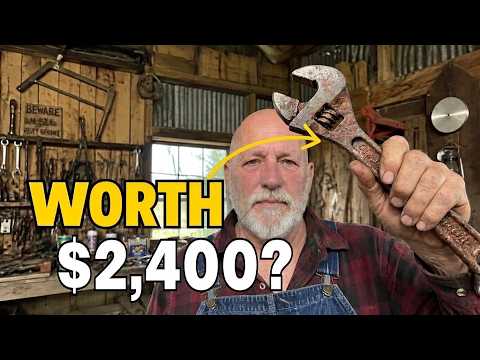
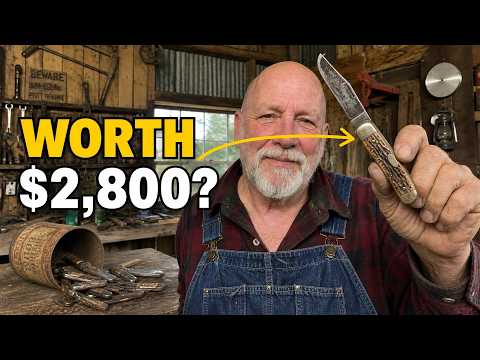
price_questionPersona holding the object; 'WORTH $2,400?' in yellow caps with the question mark; one arrow to the object's tell; barn or workshop background.

Persona bible
| Name | Otis Granger |
| Age | 64 |
| Credential | I clean out houses for a living. 40 years of barns and estate auctions across the Midwest. |
| Region | Iowa, Illinois, Wisconsin, Nebraska, a good piece of Missouri |
| Origin | 160 acres outside Cedar Rapids; mother Ruth |
| Catchphrase | That is how the old folks did it. That is still how it is done in any farmhouse that remembers. |
| Voice | Plain, unhurried, no contractions, concrete nouns, prices and place names, never 'in this video'. |
Do not
- Niche object classes (golf clubs, WW2, jewellery, CorningWare) lost 20x to universal ones.
- Do not run the same object class more than twice in a month.
- Never claim a number without a range and the honest odds.