The 20 Minute Japanese Hack to Unclog Your Catalytic Converter
Car Care Garage · 132.5K views · 2026-05-08 · 13.9x outlier
Title analysis
The {Duration} {Culture} Hack to Unclog Your {Object} · novelty · tutorial
Specific short timeframe plus exotic cultural framing signals a surprisingly fast fix.
Title features
10 words · number
Script
4348 words · 169 wpm · 25.8 min
Full transcript with timestamps
00:00 Hi, my name is Adrian and this is Car
00:02 Care Garage.
00:03 3 months ago a dealership handed me a
00:05 repair quote for $1,200
00:08 >> [music]
00:08 >> and told me my catalytic converter was
00:10 dead.
00:11 I drove home, spent 20 minutes on the
00:13 highway, and watched that check engine
00:15 light turn itself off 2 days later. The
00:17 converter is still working perfectly.
00:20 The dealership never got a single
00:21 dollar. What I used wasn't a magic
00:23 spray, an expensive tool, or some
00:26 sketchy Italian tune-up. It was a
00:28 documented Japanese engineering
00:29 technique that's been quietly saving
00:31 catalytic converters since [music] 1984
00:34 and almost nobody in America talks about
00:36 it.
00:37 What a catalytic converter actually does
00:40 and why yours is slowly [music] dying.
00:43 Let me give you the version of this
00:45 explanation that your high school auto
00:46 shop teacher probably skipped. Your
00:49 catalytic converter sits in the exhaust
00:51 stream between your engine and your
00:53 muffler. Inside that metal shell is a
00:55 ceramic honeycomb structure coated with
00:58 platinum, palladium, and rhodium.
01:00 [music]
01:01 Three precious metals. On a good day,
01:03 that honeycomb structure contains over 1
01:06 million tiny cells, each one coated with
01:09 those metals. [music]
01:11 Each one designed to trigger a chemical
01:12 reaction every single time hot exhaust
01:15 gases pass through. That reaction
01:17 converts three toxic gases into two
01:19 harmless ones.
01:21 Carbon monoxide becomes carbon dioxide.
01:23 >> [music]
01:24 >> Unburned hydrocarbons become water
01:26 vapor. Nitrogen oxides break down into
01:28 plain nitrogen and oxygen. Your car does
01:31 this thousands of times per minute,
01:33 every minute you're driving. The
01:35 catalytic converter is one of the
01:37 hardest working components on your
01:39 entire vehicle and most drivers couldn't
01:42 point to it on a diagram. Here's where
01:44 the dying starts.
01:45 >> [music]
01:45 >> Every engine burns a small amount of
01:47 oil. Every tank of fuel contains trace
01:50 contaminants. Every cold start pushes
01:52 partially combusted fuel through the
01:54 exhaust before the engine reaches
01:56 operating temperature. Over months and
01:58 years, those contaminants don't just
02:00 pass through. They stick. [music]
02:02 Carbon deposits, oil ash, fuel residue,
02:05 and phosphorus compounds from engine oil
02:09 slowly coat those precious metal
02:10 surfaces inside the honeycomb. Cell by
02:13 cell, the converter loses its ability to
02:15 trigger the chemical reaction it was
02:17 built for. This is not sudden failure.
02:20 This is a slow strangulation.
02:22 >> [music]
02:22 >> And here's the part that cost drivers
02:24 thousands of dollars in unnecessary
02:26 repairs every [music] single year.
02:28 A partially clogged catalytic converter
02:31 mimics the symptoms of a dozen other
02:33 problems. Sluggish acceleration that
02:35 feels like a transmission issue. Rough
02:37 idle that gets misdiagnosed as spark
02:39 plugs or fuel injectors. A sulfur smell
02:41 from the exhaust that mechanics blame on
02:44 the fuel system.
02:45 >> [music]
02:45 >> Reduced fuel economy that owners chalk
02:47 up to bad gas or aging engines.
02:50 Meanwhile, the actual problem is a
02:52 honeycomb structure coated in carbon
02:54 that hasn't seen a proper cleaning in
02:56 60,000 mi. And the solution costs
02:59 nothing but 20 minutes of your time.
03:02 The $1,200 lie your mechanic tells you.
03:06 Let me tell you exactly what happened at
03:08 that dealership 3 months ago because
03:10 this conversation happens in service
03:12 bays across America every single day.
03:14 The service advisor plugged in the scan
03:16 tool, read the code, and came back with
03:19 a clipboard. Code P0420.
03:22 Catalyst system efficiency below
03:24 threshold,
03:25 >> [music]
03:25 >> bank one.
03:26 His exact words were, "Your catalytic
03:28 converter has failed. [music] You need a
03:30 new one." Parts and labor, $1,180.
03:34 They'd round it up to $1,200 by the time
03:37 the final quote hit [music] the paper. I
03:39 don't know where that extra $20 went.
03:42 Probably a diagnostic fee for the
03:44 privilege of being given wrong
03:45 information. Here is what that code
03:47 actually means. The oxygen sensor
03:49 downstream of your catalytic converter
03:51 is reporting that the converter isn't
03:53 cleaning exhaust gases efficiently
03:55 enough to meet the threshold programmed
03:57 into your car's computer.
03:59 That is all it means. It does not mean
04:02 the converter is physically broken.
04:04 It does not mean the substrate has
04:05 melted. It does not mean the shell has
04:07 cracked or the honeycomb has collapsed.
04:10 In the majority of cases, especially in
04:12 vehicles under 150,000 mi that haven't
04:16 suffered a serious engine problem, P0420
04:19 means the converter is dirty. The
04:21 precious metal surfaces are [music]
04:22 coated. The chemical reaction is
04:24 suppressed. The downstream oxygen sensor
04:27 is noticing.
04:28 >> [music]
04:28 >> A former dealership service manager in
04:30 Cleveland told Automotive Body Repair
04:32 News, and I'm paraphrasing here, that
04:34 catalytic converter replacements are
04:36 among the highest margin repairs in any
04:38 service department.
04:39 >> [music]
04:40 >> The part costs the dealer between 200
04:42 and $400 wholesale.
04:44 Labor takes 45 minutes to an hour.
04:46 [music] The customer pays over a
04:47 thousand. That math works out
04:49 beautifully for the shop [music] and
04:51 catastrophically for you.
04:53 Here's what makes this worse. Most
04:55 service technicians aren't lying to you
04:57 out of malice. They're working from a
04:59 diagnostic flowchart that says code
05:01 P0420,
05:02 check oxygen sensors. If sensors are
05:04 good, replace catalytic converter. The
05:07 flowchart doesn't have a box that says
05:09 try the Japanese heat cycle method first
05:11 because the flowchart was written by
05:13 people who profit from replacements, not
05:15 from repairs. A mechanic named Gary, who
05:18 runs an independent shop in Ohio and
05:20 asked me not to use his last name, told
05:22 me something I think about every time I
05:24 walk into a service bay.
05:25 >> [music]
05:25 >> He said most clogged cats I see could
05:27 have been saved with a single proper
05:29 highway drive at the right RPM.
05:31 Instead, the customer drove here at 40
05:33 mph on city streets. We plugged in the
05:36 scanner, saw the code, [music] and wrote
05:38 the estimate. Nobody has time to road
05:40 test a car for 20 minutes at high RPM.
05:43 Nobody gets paid for that. Nobody gets
05:46 paid for [music] that. Let that sentence
05:48 sit for a second.
05:50 What the Japanese discovered in 1984.
05:54 This is the part of the video where I
05:55 get a little nerdy. Fair [music]
05:57 warning. Stick with me because this is
05:59 the foundation of why the whole method
06:01 actually works. I have or
06:03 >> [music]
06:03 >> In 1984, Japanese automotive engineers
06:06 working with early catalytic converter
06:08 technology documented something that
06:10 would quietly influence factory
06:12 maintenance guidelines for decades.
06:14 During high load sustained highway
06:16 driving, catalytic converter bed
06:18 temperatures regularly exceeded 800°C.
06:21 At those temperatures, carbon deposits
06:23 don't just burn slowly. They combust
06:26 almost completely, leaving the precious
06:28 metal substrate surfaces clean and fully
06:30 reactive again. Toyota and Subaru
06:32 factory technical documents from the
06:34 late 1980s referenced this phenomenon in
06:37 the context of converter longevity.
06:39 Engineers noted that vehicles used
06:41 primarily for short urban trips showed
06:44 dramatically accelerated converter
06:46 degradation compared to vehicles that
06:48 regularly saw highway use.
06:50 The short trip vehicles were running
06:52 cold, never reaching the thermal
06:54 threshold needed to self-clean. [music]
06:56 The highway vehicles were accidentally
06:58 running a regenerational cycle every
07:00 time they merged onto a freeway. [music]
07:02 The chemistry behind this is
07:03 straightforward once you understand it.
07:05 Carbon deposits are essentially unburned
07:08 hydrocarbons that have polymerized onto
07:10 metal surfaces.
07:10 >> [music]
07:11 >> At low exhaust temperatures, typically
07:13 below 400°C,
07:15 those deposits are stable. They stick.
07:17 They accumulate. But above approximately
07:20 650°C,
07:22 those polymer chains break apart. The
07:24 carbon oxidizes.
07:26 >> [music]
07:26 >> The deposits convert to carbon dioxide
07:28 and water vapor and exit through the
07:30 tailpipe as harmless gas.
07:33 Your catalytic converter was literally
07:35 designed to reach these temperatures.
07:37 The precious metal substrate operates
07:39 most efficiently between 400 and 900
07:42 degrees Celsius.
07:43 The problem is that most American
07:45 drivers never give it the chance. Short
07:47 trips, low speeds, gentle acceleration,
07:50 city traffic. The converter warms up,
07:52 does partial work, cools down before it
07:55 ever reaches cleaning temperature,
07:56 [music]
07:57 and accumulates another thin layer of
07:59 deposits every single day.
08:02 40 years of Japanese engineering
08:04 documentation essentially confirms what
08:06 your catalytic converter has been trying
08:08 to tell you the entire time. It needs to
08:10 get hot. Really hot, consistently. And
08:13 most [music] of you have never let it.
08:16 The exact 20-minute protocol.
08:19 All right. This is the section you
08:21 actually came [music] for. I'm going to
08:23 walk you through this exactly the way I
08:25 did it. In exactly the way the
08:28 underlying engineering logic supports.
08:31 Before you do anything else, you need to
08:33 check one thing. Pull your oil dipstick
08:35 and look at what's on it. If you If your
08:37 oil is dark black and sitting below the
08:39 minimum line, stop reading [music] and
08:42 go do an oil change first.
08:44 Running this protocol with degraded oil
08:46 will push additional phosphorus and ash
08:48 compounds through your exhaust and
08:51 recoat the very surfaces you're trying
08:53 to clean.
08:54 Fresh oil matters. This entire method
08:57 assumes your engine is in reasonable
09:00 baseline health.
09:01 It is not a substitute for deferred
09:03 maintenance.
09:04 I cannot stress this enough. Also, check
09:07 your coolant temperature gauge works and
09:08 your car isn't running hot.
09:11 You're about to ask your engine to work
09:12 harder than it usually does.
09:14 >> [music]
09:15 >> Now is not the time to discover your
09:16 cooling system has a problem. Good. If
09:19 your maintenance is current, here's the
09:21 protocol. Step one, find a highway or a
09:24 long open road where you can legally and
09:26 safely sustain 60 to 70 mph. Not a
09:29 residential street, not a school zone. I
09:32 shouldn't have to say that, but here we
09:33 are.
09:34 Step two, let your engine [music] reach
09:36 full operating temperature before you
09:38 begin.
09:39 This means the temperature gauge is
09:41 sitting in its normal position
09:43 and has been there for at least 5 s 5
09:45 minutes.
09:46 >> [music]
09:46 >> Do not start this protocol from a cold
09:48 start. A cold catalytic converter hit
09:50 with sudden high heat can experience
09:52 thermal shock. You want a gradual
09:54 temperature ramp, not a shock. Drive
09:57 normally for 10 minutes first. [music]
09:58 Step three.
10:00 Once you're at highway speed and fully
10:01 warmed up, drop one gear manually if
10:04 you're driving an automatic.
10:05 Most modern automatics have a manual
10:07 mode or you can use the paddle shifters
10:09 if your car has them.
10:11 If you drive a manual, drop from fifth
10:13 to fourth or from sixth to fifth
10:15 depending on your gearing. The goal is
10:17 to raise your engine RPM to between
10:19 3,000 and 3,500 RPM while maintaining 60
10:24 to 65 mph. This is the sweet spot. High
10:27 enough RPM to generate serious exhaust
10:30 heat, not so high that you're screaming
10:33 the engine unnecessarily.
10:35 Step four. Hold that RPM range for a
10:37 sustained 20 minutes without stopping.
10:40 No traffic lights, no exit ramps, no
10:43 slowing for construction zones if you
10:44 can help it.
10:46 The sustained heat cycle is the entire
10:47 point. Every time you slow down and let
10:49 the exhaust cool, you interrupt the
10:51 process and the deposits restabilize.
10:54 You need 20 continuous minutes of
10:56 sustained high exhaust temperature to
10:58 trigger meaningful carbon combustion
11:00 inside the converter. Step five. [music]
11:03 Do not turn the car off immediately when
11:04 you finish. Drive normally for at least
11:07 five additional minutes at lower speeds
11:09 before parking. This allows the
11:11 converter to cool gradually rather than
11:13 trapping residual heat against the
11:15 substrate.
11:15 >> [music]
11:16 >> Rapid cool down after extreme heat can
11:18 cause micro cracking in the ceramic
11:20 honeycomb over time.
11:22 Let it breathe down slowly. That's the
11:24 complete protocol. [music]
11:26 20 minutes, no parts, no tools, no
11:29 appointment. The most common mistake
11:31 people make is doing this on city
11:33 streets by revving the engine at red
11:35 lights.
11:36 >> [music]
11:36 >> That is not the same thing and it
11:38 actually causes more harm than good.
11:40 Revving a stationary engine pushes
11:42 unburned fuel into the exhaust stream
11:45 without the high exhaust flow rate that
11:46 highway driving creates. You need both
11:48 the heat and the flow. Highway speed
11:51 >> [music]
11:52 >> generates both simultaneously. The
11:54 second most common mistake is doing this
11:56 once and expecting a miracle. If your
11:59 converter has been accumulating deposits
12:01 for 60,000 mi of city driving, 1
12:04 20-minute highway run will improve it.
12:06 It probably won't completely restore it.
12:09 Repeat this protocol three times over 2
12:11 weeks for a seriously clogged converter.
12:13 Each session burns away another layer.
12:16 The lacquer thinner amplifier method.
12:20 Now we're getting into the part of this
12:21 video that makes some people
12:22 uncomfortable. That's fine. [music]
12:24 Stay with me because the chemistry is
12:26 real and the results are documented.
12:28 There is a fuel additive method that,
12:31 when combined with the heat cycle
12:32 protocol, dramatically accelerates the
12:35 decarbonization process inside your
12:37 catalytic converter.
12:38 It doesn't come in a bottle with a race
12:40 car on the label. It doesn't cost $30 at
12:42 the parts counter. It's lacquer thinner.
12:43 [music]
12:44 Specifically, acetone-based lacquer
12:46 thinner. The kind you buy at a hardware
12:48 store for about $8 per quart.
12:50 >> [music]
12:51 >> Before anyone comments that this sounds
12:53 insane, let me walk through the
12:54 chemistry.
12:55 Lacquer thinner contains a blend of
12:57 solvents, primarily acetone, toluene,
13:00 and methyl ethyl ketone.
13:02 When added to gasoline in precise small
13:04 quantities, these solvents alter the
13:07 combustion characteristics of the fuel
13:08 mixture in two useful ways. First, they
13:11 raise the effective combustion
13:12 temperature slightly, which means
13:14 exhaust gases entering the catalytic
13:16 converter arrive hotter than normal.
13:18 >> [music]
13:18 >> Second, and more importantly, they act
13:21 as a solvent carrier inside the
13:23 combustion chamber itself, breaking down
13:25 carbon deposits before they even reach
13:27 the converter. The deposits that do
13:30 reach the converter arrive in smaller,
13:31 less adherent form and combust more
13:34 readily at the temperatures your heat
13:35 cycle protocol generates.
13:38 Here is the exact ratio. Add 2 oz of
13:40 acetone-based lacquer thinner
13:42 >> [music]
13:42 >> per 10 gallons of fuel, not more. The
13:45 goal is a slight solvent presence in the
13:47 combustion process, not a wholesale
13:49 change to your fuel chemistry. Too much
13:51 lacquer thinner can damage rubber fuel
13:53 system components and degrade injector
13:56 seals. 2 oz per 10 gallons sits well
13:59 below any threshold of concern,
14:01 according to fuel systems engineers
14:03 who've published on this topic in the
14:04 SAE technical database. Add the lacquer
14:07 thinner to your tank before you fill up
14:09 with fuel so it mixes thoroughly as the
14:12 gasoline goes in.
14:13 Then run your heat cycle protocol as
14:15 described. The combination of elevated
14:17 combustion temperature, solvent carrier
14:19 action, and sustained high exhaust flow
14:21 creates a cleaning environment [music]
14:22 inside your catalytic converter that
14:25 either method alone can't fully
14:27 replicate. [music]
14:28 What does this feel like from inside the
14:30 car?
14:31 Honestly, for the first few minutes,
14:32 nothing dramatic.
14:34 Around the 8 to 12-minute mark of the
14:36 heat cycle, if your converter was
14:37 significantly clogged, you may notice a
14:40 brief sulfur or burnt smell from the
14:42 exhaust.
14:43 That's the carbon deposits combusting.
14:45 It's temporary. It means it's working.
14:47 Some people describe it as a brief
14:49 rotten egg smell. Others say it smells
14:51 like a campfire for about 90 seconds.
14:54 Either way, it passes and what's
14:55 happening during those 90 seconds is
14:57 40,000 mi of accumulated deposits
15:01 burning off the precious metal substrate
15:03 surface. After the heat cycle, some
15:05 vehicles show visible wisps of white or
15:07 gray smoke from the exhaust for a minute
15:09 or two. Again, this is the combustion
15:11 byproducts clearing. Let the car idle
15:13 for a few minutes after parking and it
15:15 clears completely. One critical note, do
15:17 not use lacquer thinner in a vehicle
15:19 that uses a flex fuel system rated for
15:21 E85 ethanol blends.
15:24 The solvent chemistry interacts
15:25 differently with ethanol-heavy fuels.
15:27 Standard gasoline vehicles, including
15:29 those rated for E10, which is nearly
15:32 every car on the road in America, are
15:34 fine at the 2 oz per 10 gallon ratio.
15:37 How to know if it worked?
15:39 Here's the honest answer. You might not
15:41 know immediately. The check engine light
15:43 that brought you to this video was
15:45 [music] triggered by the downstream
15:46 oxygen sensor reporting inefficiency.
15:49 That sensor is comparing the oxygen
15:50 content of exhaust entering the
15:52 converter [music] to the oxygen content
15:54 exiting it. A clean, fully functional
15:57 converter consumes oxygen aggressively
15:59 during the conversion reactions. A dirty
16:01 [music] one lets more oxygen pass
16:03 through unreacted. The computer notices.
16:06 The light comes on. After your heat
16:08 cycle protocol, the converter needs time
16:10 to demonstrate its restored performance
16:12 to the computer. The computer doesn't
16:14 instantly recognize improvement. It runs
16:16 a series of readiness monitors over your
16:19 next several drive cycles before it
16:21 re-evaluates the catalyst efficiency and
16:24 either clears the code or keeps it
16:26 active. For most vehicles, if the method
16:28 worked, the check engine light
16:30 extinguishes on its own within two to
16:32 four days of normal driving following
16:34 the protocol. Not immediately. Two to
16:36 four days. Uh my light went off on the
16:38 second day. I've heard from people who
16:40 waited four days before they saw it go
16:42 dark. One guy emailed me to say his took
16:44 five days and then he panicked and then
16:46 it went off on day six.
16:48 Patience. The physical signs you can
16:50 check before the light clears.
16:53 Start the car cold and let it idle.
16:55 A partially unclogged converter often
16:57 produces a slightly rough idle due to
16:59 back pressure in the exhaust system.
17:01 After successful cleaning cycle, idle
17:03 typically smooths out noticeably. It's
17:05 uh subtle, but it's there. If you've
17:07 been living with a stumble at idle for
17:09 months, you'll notice the difference.
17:11 And the acceleration test. Get onto a
17:13 highway entrance ramp and accelerate
17:14 hard from 40 to 70 mph. A [music]
17:17 clogged converter creates back pressure
17:20 that restricts exhaust flow and kills
17:22 power delivery, especially in the mid
17:24 RPM range.
17:25 >> [music]
17:25 >> After cleaning, that restriction lifts.
17:27 The car pulls harder. Some people
17:29 describe it as feeling like they got a
17:30 new engine. I'd say it feels more like
17:32 someone finally opened a window that had
17:34 been stuck for 2 years. If you have
17:36 access to an OBD-II scanner, check the
17:39 live data on your downstream oxygen
17:41 sensor,
17:41 >> [music]
17:41 >> which is the sensor after the converter.
17:44 A healthy, clean converter produces a
17:46 downstream oxygen sensor reading that
17:48 stays relatively flat and stable
17:50 compared to the upstream sensor, which
17:52 oscillates rapidly. If your
17:54 post-cleaning downstream sensor reading
17:56 has shifted toward that stable pattern,
17:58 the converter is functioning properly
18:00 again.
18:01 That's the data confirmation.
18:03 Ah, when this won't work and what to do
18:06 instead.
18:08 I want to be straight with you here
18:10 because this channel doesn't hide the
18:11 limits of what it recommends. The heat
18:14 cycle and lacquer thinner protocol works
18:16 on clogged catalytic converters.
18:19 >> [music]
18:19 >> It does not work on physically destroyed
18:21 ones. There is a difference and you need
18:23 to know how to tell them apart before
18:25 you spend 3 weeks running highway
18:27 protocols on a converter that needs
18:29 replacement. Physical destruction
18:31 happens in specific identifiable
18:33 scenarios. The first is impact damage.
18:36 Your catalytic converter sits low on the
18:38 underside of the vehicle. In many cars,
18:40 it sits barely 4 in from the ground. A
18:43 serious impact with road debris, a curb
18:46 strike, or a hard bottom out can crack
18:48 or collapse the internal ceramic
18:50 honeycomb. When that happens, chunks of
18:52 substrate break loose and either lodge
18:54 inside the converter, restricting flow
18:56 catastrophically, or get pushed
18:58 downstream and damage your oxygen
19:00 sensors. If you hit something hard and
19:02 your check engine light came on within
19:04 24 hours of that impact, don't run the
19:06 protocol. Get underneath the car
19:08 >> [music]
19:08 >> and physically inspect the converter
19:10 shell for dents. The second is coolant
19:13 contamination.
19:14 >> [music]
19:14 >> If your head gasket has failed and
19:16 coolant has been entering your
19:17 combustion chambers, the resulting steam
19:19 and coolant compounds coat the catalytic
19:21 substrate with a silicate glaze that no
19:24 amount of heat will remove.
19:25 >> [music]
19:26 >> The glazing is chemically bonded to the
19:28 precious metals. It's permanent. The
19:30 symptoms of a coolant contaminated
19:31 converter include sweet-smelling white
19:34 exhaust smoke that doesn't clear after
19:35 warm-up and a check engine light
19:37 accompanied by coolant loss that you
19:39 can't trace to an external leak. Fix the
19:41 head gasket first, then deal with the
19:44 converter. The third is oil consumption
19:46 damage. Similar to coolant
19:48 contamination, but with phosphorus
19:50 compounds from engine oil. [music] If
19:52 your engine is consuming more than a
19:53 quart of oil per 1,000 mi, the
19:56 phosphorus additives in that oil are
19:58 steadily poisoning your catalytic
20:00 converter surfaces.
20:01 The heat cycle protocol can slow this
20:04 process and temporarily restore some
20:06 function, but it won't overcome active
20:08 ongoing contamination. If your engine
20:10 has a serious oil consumption problem,
20:12 the converter is a symptom, not the root
20:14 cause. Me, how do you tell a clogged
20:17 converter from a destroyed one without a
20:19 $1,000 diagnostic? The back pressure
20:21 test. Find the oxygen sensor port
20:24 upstream of your converter, which is the
20:25 first bung in the exhaust pipe before
20:27 the converter shell. Remove the sensor
20:29 temporarily and insert a vacuum gauge
20:31 hose adapter. At idle, exhaust back
20:34 pressure in a healthy system should be
20:36 under 1 PSI. On a seriously clogged
20:38 converter, you'll see 2 to 4 PSI or
20:41 higher. On a physically destroyed or
20:43 collapsed converter, you'll sometimes
20:45 see almost no back pressure at all
20:47 because the gases are bypassing the
20:49 substrate entirely through the collapsed
20:51 sections. Zero back pressure on that
20:54 test with a P0420
20:56 code is a strong indicator of physical
20:59 failure, not clogging. [music]
21:01 The maintenance habit that keeps your
21:03 cat clean forever.
21:06 Here's the part of the video that saves
21:08 you from having this conversation with
21:09 yourself again in 3 years.
21:12 The fundamental reason catalytic
21:13 converters clog is thermal deprivation.
21:17 Short trips, low speeds, gentle driving,
21:19 urban stop-and-go, the converter never
21:21 gets hot enough to self-clean. Deposits
21:23 accumulate because the operating
21:25 conditions never trigger combustion of
21:27 those deposits. You could have the
21:29 cleanest fuel, the freshest oil, and a
21:32 perfectly tuned engine, and a diet of
21:34 nothing but 8-mile round trips to the
21:37 grocery store will still slowly strangle
21:39 your converter. The prevention protocol
21:41 is almost insultingly simple. Once per
21:43 week, take your car on a 20-minute
21:45 highway drive. Not a highway cruise
21:47 where you're doing 55 in the slow lane
21:49 behind a delivery truck, a genuine
21:51 sustained 60 to 70 mph drive in a gear
21:54 that puts your RPM between 2,500
21:58 and 3,000. This doesn't need to be the
22:00 full heat cycle protocol with lacquer
22:02 thinner.
22:03 >> [music]
22:03 >> This is just normal highway driving done
22:05 with intention and consistency. You're
22:07 allowing your converter to reach and
22:08 sustain its operating [music]
22:09 temperature range. You're triggering
22:12 natural self-cleaning. You're doing
22:14 exactly what the Japanese engineers
22:15 documented in 1984. If your life
22:18 genuinely doesn't allow for a weekly
22:20 highway drive because you live in a city
22:22 and never need to leave it, the lacquer
22:24 thinner treatment at the 2 oz per 10
22:26 gallon ratio run every 6 months
22:29 accomplishes much of the same protective
22:31 function. It's maintenance, [music]
22:33 not repair.
22:34 The difference between those two
22:35 categories is usually about $900. Fuel
22:39 quality matters more than most drivers
22:41 realize.
22:41 >> [music]
22:41 >> Top Tier gasoline, which is a
22:44 certification you can look up by brand
22:45 at the Top Tier website, contains
22:47 detergent additive packages at
22:49 concentrations that exceed federal
22:51 minimums. Those detergents reduce
22:53 combustion chamber deposits, which
22:55 reduces the volume of contaminated
22:57 exhaust gases that your converter has to
22:59 process. The difference between Top Tier
23:01 and a non-top-tier fuel is not dramatic
23:04 on a per [music] tank basis. Over 50,000
23:07 mi, it's the difference between a
23:09 converter that's functioning at 90% and
23:11 one that's functioning at 60%. Check
23:14 your air filter every 15,000 mi. A
23:17 clogged air filter richens the fuel
23:19 mixture, pushing unburned hydrocarbons
23:21 into the exhaust stream in higher
23:23 concentrations. Your converter handles a
23:25 certain load of unburned hydrocarbons as
23:27 part of normal operation. Push that load
23:30 above its capacity, and the excess
23:32 deposits on the substrate. An $8 air
23:34 filter is converter maintenance. Most
23:36 people don't think of it that way.
23:38 Finally, address oil consumption early.
23:40 If you're adding oil between changes,
23:42 find [music] out why. Worn valve seals,
23:44 worn piston rings, a leaking turbo seal
23:47 on turbocharged engines.
23:49 >> [music]
23:49 >> Any of these conditions are slowly
23:50 poisoning your converter with every mile
23:53 you drive. The repair you're avoiding to
23:55 save money today is building toward the
23:57 repair you'll be forced to make tomorrow
23:59 at 10 times the cost. I know that's not
24:01 a fun thing to hear. It is true. 3
24:03 months ago, a dealership told me my
24:05 catalytic converter was dead and handed
24:07 me a quote for $1,200.
24:10 I drove home. I checked my oil. I found
24:12 a long empty stretch of highway.
24:14 >> [music]
24:14 >> I drove for 20 minutes at 3,000 RPM. I
24:17 repeated that twice over the following 2
24:19 weeks. On the second day after the third
24:21 run, the check engine light went off on
24:23 its own while I was sitting at a red
24:25 light. I actually laughed out loud in
24:26 the car. The guy in the lane next to me
24:28 probably thought I was having some kind
24:29 of episode. Honestly, [music] fair. That
24:32 converter is still working today.
24:35 I have driven over 9,000 mi since that
24:37 dealership visit. The light has not
24:39 returned.
24:41 Total cost of the repair?
24:42 $0 and approximately 60 minutes of
24:45 highway driving spread over 2 weeks.
24:47 That is what Car Care Garage is here
24:49 for. Not to sell you products, not to
24:51 tell you everything is fine when it
24:53 [music] isn't, not to pretend that every
24:55 repair requires a shop visit and a
24:57 credit card. This channel exists because
24:59 the information gap between what
25:01 mechanics know and what drivers know is
25:04 costing American car owners billions of
25:07 dollars every single year. And most of
25:09 the time bridging that gap costs nothing
25:12 but the willingness to understand what
25:14 your car is actually telling you.
25:16 If this video has just saved you from
25:18 writing a four-figure check for a
25:19 converter that only [music] needed a
25:21 proper cleaning, hit that like button,
25:23 subscribe to Car Care Garage, and share
25:26 this with someone you know who's been
25:27 quoted a crazy number for a repair that
25:30 might not need to happen. And before you
25:32 go,
25:33 our next video exposes the engine oil
25:35 interval myth that's quietly destroying
25:37 engines that should last [music] 300,000
25:39 mi. Watch it before your next oil
25:41 change. You need to hear this.
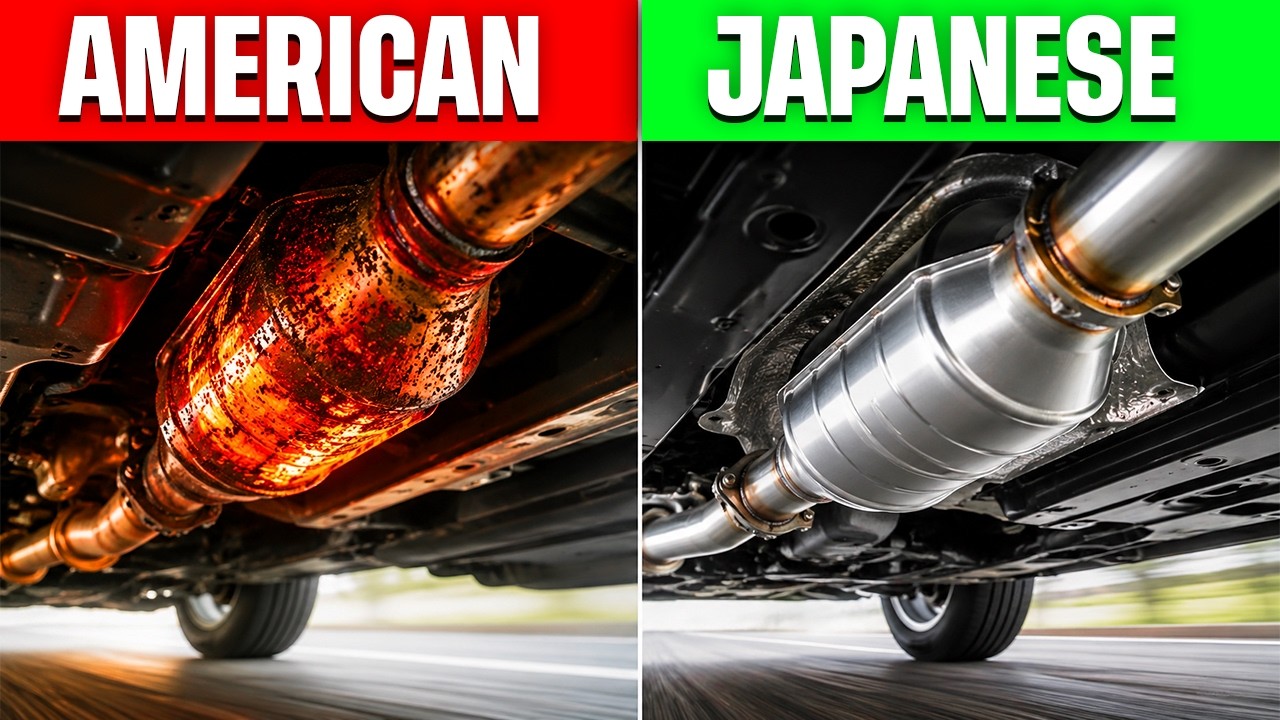
Thumbnail analysis
Pattern: Comparison split Trigger: Contrarian
Curiosity 6 · FOMO 2 · Pain 6 · Clarity 8
Text: AMERICAN JAPANESE · Face: no
the rusty vs pristine comparison visually dramatizes the promise of the 'hack' and taps national rivalry plus a concrete cheap fix.
Improvement: add a bold number or before/after arrow overlay showing the 20-minute time claim directly on the image.