15 Odd Dog Behaviors and What They Actually Mean
Midnight Oracle · 428.3K views · 2026-04-03 · 177.8x outlier
Title analysis
{N} Odd {animal} Behaviors and What They Actually Mean · curiosity_gap · list
Naming odd behaviors viewers recognize creates instant relevance and desire for explanation.
Title features
9 words · number
Script
2753 words · 164 wpm · 16.8 min
Hook: If you live with a dog, you probably know that they exhibit some strange behaviors which pique our curiosity. In this video, we will talk about 15 strange things dogs do and explain the meaning behind them.
Type / score: list_promise · 5/10
Structure: list
Promise: full
Tone: informative, calm, mildly playful
Diagnosis: The countdown structure and consistent 'why does my dog do X' framing keeps a clear, title-matching promise and each segment resolves cleanly, which sustains casual curiosity-driven viewers throughout. However, with no persona, uniform pacing, and no escalating stakes or callbacks between items, engaged viewers may drift off partway through since each segment is interchangeable and skippable rather than building momentum toward a payoff.
Full transcript with timestamps
00:01 If you live with a dog, you probably
00:02 know that they exhibit some [music]
00:04 strange behaviors which pique our
00:06 curiosity.
00:07 In this video, we will talk about 15
00:10 strange [music] things dogs do and
00:11 explain the meaning behind them.
00:17 Number 15. [music]
00:19 Why dogs eat grass.
00:21 You are out on a walk or in the backyard
00:24 >> [music]
00:24 >> and your dog suddenly drops their nose
00:26 to the ground and starts chomping on
00:27 grass like a little cow.
00:30 This is one of the most commonly
00:31 observed and most frequently
00:32 misunderstood dog behaviors. Many people
00:34 assume that dogs eat grass [music] only
00:36 when they feel sick and want to vomit.
00:39 But studies have shown that the majority
00:40 of grass-eating dogs show no signs of
00:43 illness beforehand and do not vomit
00:46 afterward.
00:47 So, what is [music] actually going on?
00:50 Dogs are omnivores by nature and grass
00:53 [music] may simply provide fiber, plant
00:55 nutrients, or digestive benefits that
00:57 they instinctively [music] seek out.
00:59 It is also thought to be a behavior
01:01 inherited from their wild ancestors
01:02 >> [music]
01:03 >> who regularly consume the stomach
01:04 contents of their prey
01:06 which often included plant matter.
01:08 >> [music]
01:09 >> In most cases, grass-eating is
01:10 completely harmless.
01:12 The main concern is making sure the
01:14 grass has not been treated with
01:15 pesticides or fertilizers [music]
01:17 which can be toxic to dogs.
01:23 Number 14. [music]
01:26 Why dogs tilt their head.
01:29 >> [music]
01:29 >> Few things are more instantly charming
01:31 than a dog tilting their head to one
01:32 side while you talk to them.
01:35 But there is more going on than just
01:36 being cute.
01:38 When dogs tilt their heads, they are
01:39 trying to hear you better.
01:41 Dogs have mobile outer ears that they
01:43 can adjust to better capture sound
01:45 >> [music]
01:45 >> and tilting the head helps them pinpoint
01:47 where a sound is coming from and filter
01:49 out background noise.
01:51 Some researchers also believe that dogs
01:53 tilt their heads to see your face more
01:55 clearly.
01:56 A dog's muzzle
01:57 >> [music]
01:57 >> can actually obstruct their lower field
01:59 of vision
02:00 and tilting the head to one side shifts
02:02 the muzzle out of the way allowing them
02:04 to read your facial [music] expressions
02:06 more accurately.
02:08 Dogs are exceptionally good at reading
02:10 human emotions through our faces [music]
02:12 and the head tilt may be part of how
02:14 they do it.
02:15 If your dog tilts their head a lot when
02:16 you speak to them
02:18 it is a sign they are engaged attentive
02:20 >> [music]
02:21 >> and trying their hardest to understand
02:22 you.
02:26 Number 13.
02:28 Why dogs yawn.
02:30 You might assume your dog yawns for the
02:32 same reason you do, because they are
02:34 tired.
02:35 >> [music]
02:35 >> And sometimes that is true, but dogs
02:37 also yawn as a calming signal, which is
02:39 a form of nonverbal communication used
02:41 [music] to manage social tension.
02:43 When a dog feels stressed,
02:45 uncomfortable, or wants to de-escalate a
02:47 situation
02:48 they will often yawn as a way of
02:50 signaling [music] to other dogs or to
02:52 people that they mean no harm and want
02:54 things to stay calm.
02:56 You will often see a dog yawn during a
02:58 vet visit, when being approached by a
03:00 stranger, or when their owner is
03:02 speaking to them in a firm tone. [music]
03:04 If you notice your dog yawning in
03:06 situations that do not involve
03:07 sleepiness
03:09 pay attention to the [music] context.
03:11 They are likely trying to tell you
03:12 something about how they are feeling.
03:15 You can even try yawning back at your
03:16 dog.
03:18 Many dogs recognize it as a calming
03:19 [music] gesture
03:21 and will respond to it.
03:25 Number 12. [music]
03:28 Why dogs roll in smelly things.
03:31 You just gave your dog a bath. They
03:33 smell [music] clean and fresh.
03:36 You let them outside for 5 minutes and
03:37 they come back covered in [music]
03:38 something absolutely disgusting. Rolling
03:41 in strong, unpleasant smells is one of
03:44 the most baffling behaviors dogs engage
03:46 in and the leading theory goes back to
03:48 their wild ancestors. Wolves and wild
03:51 dogs are thought to [music] roll in
03:53 strong scents to mask their own smell
03:55 while hunting making it easier to
03:57 approach prey without being detected.
04:00 Another theory suggests that by rolling
04:02 in an interesting [music] scent a dog is
04:04 essentially collecting a sample to bring
04:06 back and share with the rest of the
04:08 pack, a form of scent communication.
04:11 Whatever the reason
04:13 the behavior is deeply hardwired [music]
04:15 which is why even the most well-trained
04:17 dogs will give in to it the moment they
04:19 find the right patch of something
04:21 revolting to roll in.
04:26 Number 11.
04:27 Why dogs [music] dig.
04:30 Dogs dig for a variety of reasons and
04:32 understanding which one applies to your
04:34 dog depends on the context. In the wild,
04:37 dogs dug to bury food and save it for
04:39 later, to create cool resting spots in
04:41 warm weather, to build dens for
04:43 birthing, and to flush out [music] small
04:45 prey
04:46 hiding underground.
04:48 Domestic dogs retain all of these
04:50 instincts.
04:51 If your dog digs in a specific corner of
04:53 the yard and seems to be burying toys or
04:55 treats
04:56 they are engaging in caching [music]
04:58 behavior
04:59 saving resources for later.
05:02 If they are digging [music] shallow
05:03 scrapes in the dirt or grass and then
05:06 lying in them, they are creating a cool
05:08 surface to rest [music] on.
05:10 And if they are digging frantically and
05:11 persistently near the fence line,
05:13 >> [music]
05:13 >> they may be trying to escape out of
05:15 boredom or frustration.
05:17 Dogs that do not get enough exercise and
05:19 mental stimulation [music]
05:21 are much more likely to dig excessively
05:23 as a way of releasing pent-up energy.
05:29 Number 10.
05:31 Why [music] dogs sleep with open eyes.
05:35 Yes, you read that right.
05:37 Some dogs sleep with their eyes
05:39 partially open and if you have ever
05:41 witnessed it, it can be [music]
05:42 genuinely startling.
05:44 But what you are actually seeing is not
05:46 the surface of the eyeball.
05:49 Dogs have a third eyelid, a pinkish
05:51 [music] membrane called the nictitating
05:52 membrane
05:54 that sweeps across the eye when a dog is
05:56 asleep to keep it moist and protected.
05:59 When the dog is awake, this membrane
06:01 retracts to the inner corner of the eye.
06:04 Some theories suggest that dogs evolved
06:06 this ability
06:07 >> [music]
06:07 >> as a survival adaptation.
06:10 Sleeping while appearing to be awake
06:12 could trick predators into thinking
06:14 [music] the dog was still alert and
06:15 ready to respond.
06:18 So, if your dog looks like they are
06:19 staring at you with [music] glazed,
06:20 half-open eyes while completely passed
06:22 out, do not be alarmed.
06:25 They are simply sleeping with their
06:26 third eyelid [music] doing its job.
06:32 Number nine.
06:34 Why dogs [music] pant.
06:37 More often than not, dogs pant to cool
06:39 themselves down.
06:40 Unlike humans, dogs [music] are not able
06:42 to regulate their body temperature using
06:44 sweat across their skin.
06:46 They only have sweat glands on their paw
06:48 pads, which are not sufficient to cool
06:51 the whole body.
06:52 So, instead, they pant which circulates
06:54 cool air through their bodies and
06:56 evaporates water from the mouth tongue,
06:59 and upper respiratory tract, [music]
07:01 releasing heat in the process.
07:04 Dogs may also pant when they are feeling
07:06 stressed [music] or anxious.
07:08 You will often see this type of panting
07:10 during visits to the vet, [music] during
07:12 thunderstorms, or when fireworks are
07:13 going off outside.
07:15 In these situations, the panting is
07:16 often accompanied by other signs of
07:18 stress [music] like yawning, whining,
07:20 lip licking, or hiding.
07:22 Panting is also a normal response to
07:24 excitement. Meeting new people, [music]
07:26 anticipating a walk, or receiving a
07:28 treat can all trigger a panting
07:30 response.
07:31 The key is reading the panting in
07:32 context with the rest of your dog's body
07:35 language.
07:39 Number eight.
07:40 >> [music]
07:40 >> Why dogs lick your face. Dogs lick the
07:43 faces of the people they are bonded with
07:44 for several deeply rooted reasons.
07:46 [music]
07:47 First, it is a submissive and
07:48 affectionate gesture inherited from wolf
07:50 behavior.
07:51 Puppies lick the mouths of adult wolves
07:53 to solicit food and to express [music]
07:55 deference.
07:57 When your dog licks your face they are
07:59 partially acting on the same instinct
08:01 [music] or showing respect and affection
08:03 towards someone they see as a trusted
08:05 authority figure.
08:08 Licking is also a bonding behavior.
08:09 >> [music]
08:10 >> It releases endorphins in dogs and makes
08:12 them feel calm and connected.
08:14 And of course, human [music] faces often
08:16 carry traces of food, sweat, and other
08:19 interesting flavors that [music] dogs
08:20 find genuinely appealing.
08:23 >> [clears throat]
08:23 >> If your dog is an enthusiastic face
08:25 licker, they are almost certainly
08:27 expressing love, though you are also
08:29 probably just a little bit [music]
08:30 tasty.
08:34 Number seven.
08:36 Why dogs [music] circle before pooping.
08:39 Dogs circle before they poop for several
08:41 reasons. By spinning [music] in circles
08:43 before relieving themselves, your dog is
08:45 making sure there are no threats hiding
08:47 in the grass.
08:49 Going to the bathroom puts [music]
08:50 anyone in a vulnerable position
08:52 and if a dog is squatting
08:54 they cannot easily protect themselves.
08:57 Circling allows them to survey the area
08:59 and make sure it is safe before [music]
09:00 committing.
09:02 Scent marking their territory is another
09:04 reason why dogs circle before they
09:06 eliminate.
09:07 Dogs have scent glands on their paws so
09:10 as they spin [music] and step across the
09:11 ground, they are leaving behind chemical
09:13 messages for other dogs.
09:15 Interestingly
09:17 researchers have also concluded that
09:18 dogs prefer to align their bodies along
09:21 the Earth's north-south magnetic axis
09:23 when defecating.
09:25 By circling before going your dog may be
09:27 trying to [music] find that precise
09:28 alignment.
09:30 Sounds strange, but the data is
09:31 surprisingly consistent across multiple
09:33 studies.
09:37 Number six.
09:39 Why dogs bring you their toys. [music]
09:42 When you come home after a long day and
09:43 your dog races to greet you with a toy
09:46 hanging from their mouth, [music]
09:47 it is tempting to simply think they want
09:49 to play.
09:50 And sometimes they do.
09:52 But there is often something more
09:53 meaningful going on.
09:56 Dogs bring their [music] owners toys as
09:57 a form of gift giving,
09:59 a behavior rooted in the pack mentality
10:01 [music] of their ancestors.
10:04 In a pack, sharing resources is a sign
10:06 of trust [music] and affection.
10:08 Your dog bringing you a toy is their way
10:10 of welcoming you, showing you they are
10:12 happy to see you,
10:13 and offering you something [music]
10:14 valuable.
10:16 Some dogs do it because they have
10:18 learned that presenting a toy gets a
10:19 positive [music] reaction from their
10:21 owner, praise, attention, play, and they
10:24 repeat it for that reward.
10:27 Either way, [music] a dog that greets
10:28 you with a toy
10:30 is a dog that is genuinely excited you
10:33 came home.
10:37 Number five.
10:39 >> [music]
10:40 >> Why dogs smell people's crotches.
10:43 Dogs sniff people's crotches for the
10:45 same reasons they sniff each other's
10:47 behinds.
10:49 The growing area has a high
10:50 concentration of apocrine [music]
10:52 glands, the same type of glands found
10:54 near a dog's tail that release
10:55 pheromones carrying detailed social
10:57 information.
10:58 When a dog sniffs a person in this area,
11:01 they are trying to gain information
11:02 about that individual, [music]
11:04 including their age, sex, health, and
11:07 emotional state.
11:09 Humans may find this behavior
11:10 embarrassing or rude, but to a dog, it
11:13 is simply a straightforward [music] and
11:14 efficient way of gathering information
11:17 about someone new.
11:19 People who have recently had sexual
11:20 intercourse, women who are menstruating
11:22 or pregnant,
11:23 >> [music]
11:23 >> and individuals who are experiencing
11:24 high stress or illness, tend to attract
11:27 more of this attention
11:29 because their pheromone output is
11:30 higher.
11:31 The best way to discourage the behavior
11:34 is [music] to redirect your dog calmly
11:35 rather than reacting with alarm, as an
11:38 excited reaction can [music] actually
11:40 reinforce it.
11:44 Number four.
11:45 Why dogs expose their belly to you.
11:48 More often than [music] not,
11:50 belly exposing behavior in dogs
11:52 indicates trust and acceptance. When
11:55 your dog rolls over and shows you
11:56 [music] their belly, it is a sign that
11:58 they feel completely safe around you and
12:00 comfortable enough to expose [music] one
12:01 of their most vulnerable areas.
12:04 But belly exposing behavior can also
12:06 mean something altogether different.
12:07 [music]
12:09 A dog may roll onto their back as a
12:11 submissive display to avoid
12:12 confrontation,
12:13 >> [music]
12:13 >> not because they want a belly rub, but
12:15 because they are appeasing a perceived
12:17 threat.
12:18 In the wild, wolf pack members would
12:20 adopt this submissive posture to diffuse
12:22 [music] social tension and show they are
12:23 not a challenge.
12:25 To know whether your dog is showing
12:26 trust or submission, [music]
12:28 look at the whole body.
12:30 A dog that feels safe will have a loose,
12:31 [music] relaxed posture with a gently
12:34 wagging tail.
12:35 A dog showing submissive appeasement
12:37 will often look tense,
12:38 >> [music]
12:38 >> freeze up, or show other signs of
12:40 anxiety.
12:42 Petting a dog in the second scenario can
12:44 actually make them more nervous rather
12:45 than less.
12:50 Number three.
12:52 Why dogs follow you everywhere.
12:55 There are straightforward [music]
12:56 scientific and behavioral reasons behind
12:59 a dog's tendency to follow their owner
13:01 from room to room.
13:03 Over thousands of years of
13:04 domestication, [music]
13:06 humans selectively bred dogs for
13:07 companionship and cooperation.
13:10 These animals evolved from wolves who
13:12 lived in [music] tightly bonded packs,
13:14 and that social wiring did not
13:15 disappear.
13:17 It simply redirected toward humans.
13:18 [music]
13:20 Your dog follows you because you are
13:21 their pack, and being near you feels
13:23 [music] natural and safe.
13:26 Positive reinforcement also plays a
13:27 role.
13:29 If being close to you regularly results
13:31 in affection, [music]
13:32 treats, play, or exciting activities
13:34 like walks, your dog quickly [music]
13:36 learns that staying near you is a
13:38 reliable source of good things.
13:40 Young puppies in particular imprint
13:42 strongly on their caregivers, seeing
13:44 them as parental figures and following
13:45 them [music] instinctively. And of
13:47 course, at its most basic level, a dog
13:50 that follows you everywhere
13:53 is a dog that loves you
13:55 and simply [music] wants to be where you
13:57 are.
14:01 Number two.
14:03 Why dogs take your spot. You get up from
14:06 your chair or your spot on [music] the
14:08 couch, and by the time you come back,
14:10 your dog has fully claimed it and is
14:12 looking at you with complete
14:13 satisfaction.
14:15 Dogs steal your seat primarily [music]
14:16 because of the warmth and scent you
14:18 leave behind.
14:19 Your body heats up whatever surface you
14:21 sit on,
14:21 >> [music]
14:22 >> and dogs are drawn to warm resting
14:23 spots.
14:25 Your scent also lingers on the cushion,
14:28 and being surrounded by your smell is
14:30 comforting and reassuring to a dog that
14:32 is bonded to you.
14:34 There is also a social element to it.
14:36 Dogs with a [music] pack mentality enjoy
14:38 being in close contact with the things
14:40 and places associated with their family
14:42 [music] members.
14:44 Sitting in your spot is their way of
14:45 staying connected to you even when you
14:47 are not [music] there.
14:49 Some dogs also do it specifically to
14:51 prompt you to sit beside them when you
14:53 come back, which from their perspective
14:55 is a perfect [music] outcome.
15:00 Number one.
15:01 Why dogs eat snow.
15:04 More often than not, dogs eat snow
15:06 because [music] they are thirsty.
15:08 Winter brings very dry air, and dogs
15:10 lose a significant amount of body
15:12 moisture through their breath and
15:13 panting.
15:15 Before dogs were domesticated, their
15:16 ancestors [music] in colder climates
15:18 often had to rely on eating snow to stay
15:21 hydrated when liquid water was not
15:23 available.
15:24 Snow [music] eating is an instinctive
15:26 behavior passed down through genetics.
15:28 If you think your dog's [music] bowl
15:29 still has plenty of water,
15:32 keep in mind that dogs often prefer
15:34 fresher water. [music]
15:36 Freshly fallen snow can seem more
15:38 appealing than water that has been
15:40 sitting in a bowl for hours.
15:42 Dogs also [music] eat snow simply
15:44 because they enjoy it.
15:46 Snow is soft, cold, and unpredictable to
15:48 catch, and many dogs find it genuinely
15:50 entertaining to snap at and eat.
15:54 As long as the snow is [music] clean,
15:56 eating it in limited quantities is
15:57 generally safe.
16:00 The main danger comes from snow that may
16:01 have been contaminated by [music]
16:03 antifreeze, road salt, or other
16:05 chemicals, which can be seriously
16:07 harmful to dogs.
16:09 So, let them enjoy it, but keep an eye
16:11 on where they are eating it from.
16:17 So, there you have it. 15 strange
16:19 [music] things dogs do, all explained.
16:21 Dogs are fascinating, complex animals,
16:23 [music] and every behavior they exhibit
16:25 has a reason behind it.
16:27 The more you understand what your dog is
16:29 communicating,
16:30 the stronger and [music] more rewarding
16:32 your bond with them will become.
16:34 If you enjoyed this video, give it a
16:36 thumbs up, and leave [music] a comment
16:38 below telling us the strangest thing
16:40 your dog has ever done.
16:41 And do not forget to subscribe so you
16:43 not miss our next video.
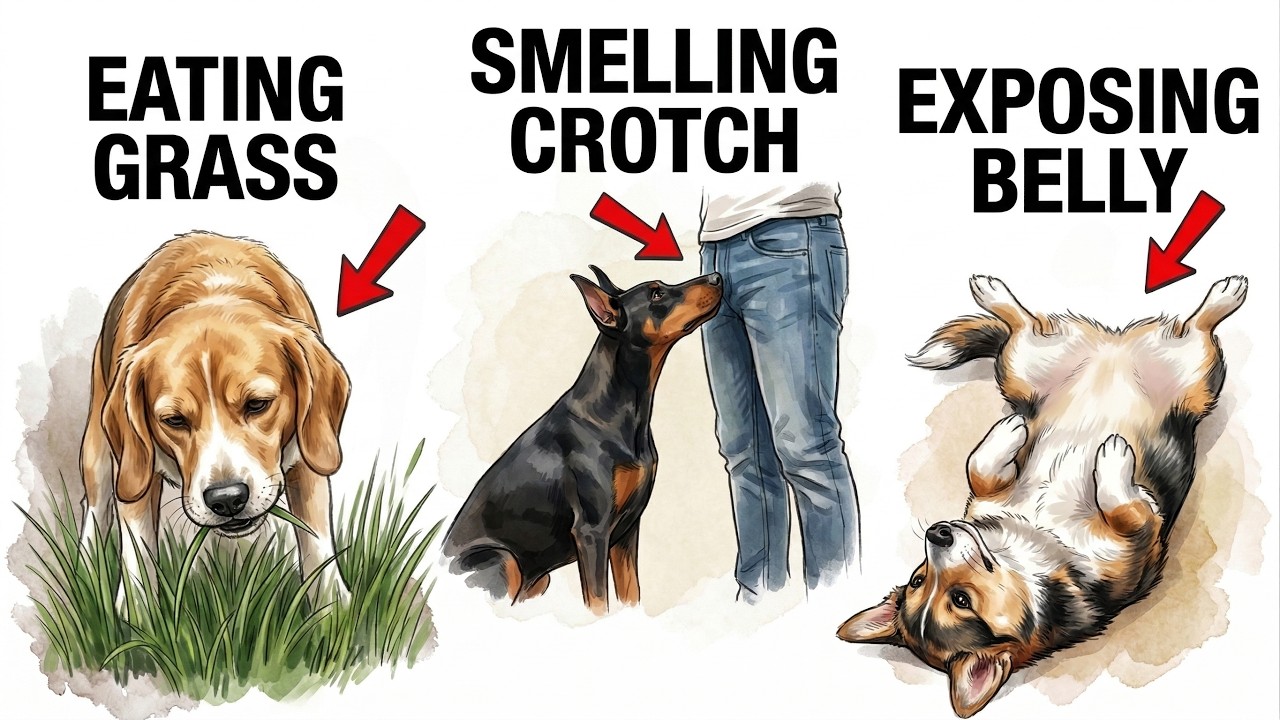
Thumbnail analysis
Pattern: List preview Trigger: Curiosity gap
Curiosity 8 · FOMO 1 · Pain 4 · Clarity 8
Text: EATING GRASS SMELLING CROTCH EXPOSING BELLY · Face: no
It lists specific, relatable dog behaviors owners recognize and dangles the explanation of their meaning, creating a curiosity gap.
Improvement: Add a small text teaser like 'What #7 means will shock you' to intensify curiosity for the full list.