We Tested Chicken From Walmart, Costco, Target, Aldi & 10 More Stores — The Results Were Shocking
America Under Pressure · 64.5K views · 2026-07-31 · 245.6x outlier
Title analysis
We Tested {product} From {stores} — The Results Were Shocking · curiosity_gap · comparison
Withholding the shocking result while listing credible stores forces a click to resolve suspense.
Title features
15 words · number
Script
4391 words · 153 wpm · 28.8 min
Hook: spent weeks tracing the chicken sold at 14 major American grocery chains, Walmart, Costco, Target, Aldi, and 10 more... 11 of these stores are selling chicken that traces back to a small handful of processors, some of which pled guilty in federal court to price fixing, while the label on the bag implies a completely different story.
Type / score: bold_claim · 8/10
Structure: list
Promise: full
Tone: snarky, investigative, myth-busting
Diagnosis: The cold open stacks concrete stakes (price-fixing, hidden ownership, labeling tricks) and a clear methodology promise that earns trust before the list even starts, which should hold viewers through the setup. Retention likely dips mid-list as store entries repeat a similar formula (premium line good, conventional line bad, same processors) without much escalation until the price-fixing and enhanced-chicken payoffs resurface near the end.
Full transcript with timestamps
00:00 spent weeks tracing the chicken sold at
00:02 14 major American grocery chains,
00:05 Walmart, Costco, Target, Aldi, and 10
00:08 more.
00:09 Back through the label, the packaging
00:11 claims, and the actual company doing the
00:14 slaughtering and the packing.
00:16 11 of these stores are selling chicken
00:18 that traces back to a small handful of
00:21 processors, some of which pled guilty in
00:24 federal court to price fixing, while the
00:26 label on the bag implies a completely
00:29 different story.
00:31 One store spent hundreds of millions of
00:33 dollars building its own farms and its
00:35 own processing plant just to protect a
00:37 $5 price tag. And the store most
00:40 shoppers assume has the strictest animal
00:44 welfare standards in the country is
00:46 quietly clearing its own bar by the
00:48 smallest possible margin. 14 stores, one
00:52 bird, and almost none of the labels are
00:54 telling you what actually matters.
00:56 Quick word on method before anyone in
00:59 the comments accuses us of hiding a
01:01 secret chicken lab in a basement
01:03 somewhere because we don't have one of
01:05 those. And if we did, this video would
01:08 probably look very different. We didn't
01:11 run bacterial testing.
01:13 What we did was pull the actual current
01:16 packaging claims off every one of these
01:18 labels. No antibiotics ever, air
01:21 chilled, no hormones added, raised with
01:24 care, whatever the phrase of the day
01:26 happens to be, and checked each one
01:29 against what it actually means under
01:31 United States Department of Agriculture
01:33 rules, then traced ownership back to the
01:35 processor. Here's the fact that's going
01:38 to reframe basically everything on this
01:41 list.
01:42 Every single chicken sold in this
01:44 country, every brand, every store, every
01:46 price point is legally required to be
01:49 free of added hormones and steroids
01:51 because the United States banned the use
01:54 of hormones and steroids in poultry
01:56 production back in the 1950s.
01:59 That means a no hormones added label on
02:01 chicken isn't a premium claim. It's a
02:04 federal requirement dressed up as a
02:06 selling point and by law the package
02:09 actually has to include a disclaimer
02:12 saying so in fine print, which almost
02:15 nobody reads. On top of that, roughly
02:18 five or six companies, Tyson, Pilgrim's
02:21 Pride, Perdue, Wayne Sanderson, Mount
02:23 Aire, and Koch Foods among them, supply
02:26 the overwhelming majority of chicken
02:28 sold under nearly every private label in
02:30 this country.
02:32 Different bag, different font, same farm
02:34 system behind almost all of it. One more
02:37 term worth knowing before we start
02:39 because it's going to come up more than
02:41 once.
02:42 A lot of commercial chicken sold in this
02:44 country is what the industry calls
02:47 enhanced, meaning it's been injected
02:49 with a saline or broth solution before
02:52 packaging,
02:53 both to keep it from drying out and to
02:55 add weight that gets sold back to you at
02:58 chicken prices, not water prices.
03:01 It's legal. It's disclosed on the label
03:04 if you know to look for a percentage of
03:06 retained solution printed in tiny type
03:09 and almost nobody checks for it.
03:12 Keep that one in your back pocket, too,
03:14 because it's going to matter a lot more
03:16 for a couple of stores near the end of
03:18 this list than you'd expect. One last
03:21 piece of vocabulary and then I promise
03:24 we'll actually get into the stores.
03:26 There's a real difference between a
03:28 claim a company just prints on a bag and
03:32 a claim that's gone through USDA process
03:34 verified certification, which means an
03:37 independent auditor has actually checked
03:39 the farms and paperwork behind that
03:42 specific claim, not just taking the
03:45 company's word for it. Raised without
03:47 antibiotics can mean either one
03:49 depending on the brand and unless you're
03:52 squinting at a small shield-shaped logo
03:55 on the package, you genuinely cannot
03:57 tell which version you're holding.
04:00 That's not a conspiracy, it's just a
04:02 labeling system that was clearly
04:04 designed by someone who has never once
04:06 stood in a grocery store aisle holding
04:09 up the checkout line while they read a
04:11 chicken label, which, respectfully, is
04:14 exactly what we did to make this video.
04:17 Keep that in mind. Let's go. Number 11,
04:20 Meijer. Same Midwest loyalty as always,
04:23 and this one's actually pretty
04:24 unremarkable in the most literal sense
04:27 of the word, which is sort of the
04:28 problem.
04:29 Meijer's fresh chicken carries a raised
04:32 without antibiotics claim on select
04:34 lines, a real and verifiable practice
04:38 difference from conventional chicken,
04:40 and a no hormones added statement
04:42 sitting right next to it doing
04:44 absolutely nothing. Because, again, no
04:47 chicken in America has hormones added.
04:50 That's not a Meijer thing, that's a
04:51 since 1959 thing. The chicken itself is
04:55 processed through the standard
04:57 commercial pipeline, sourced from one of
04:59 the handful of major integrators, and
05:01 sold at a price that reflects exactly
05:03 that. A commodity bird with one
05:06 genuinely meaningful claim sitting next
05:08 to one completely meaningless one,
05:11 printed in the same size font so you
05:13 can't tell which is which without doing
05:15 your own homework.
05:17 Nobody's writing a folk song about
05:19 Meijer chicken,
05:20 and that's fine, it's not trying to be
05:21 that. It's just funny that the
05:24 meaningless claim gets exactly as much
05:26 shelf space as the real one, printed in
05:29 the same confident font right next to a
05:31 claim that's actually been federal law
05:34 since before most of our parents were
05:35 born.
05:36 Number 10, Safeway and Albertsons,
05:39 grouped together again because they
05:41 merged supply chains after Albertsons
05:43 acquired Safeway back in 2015.
05:46 Both banners lean on the O Organics and
05:49 Open Nature labels for their premium
05:51 chicken tier,
05:52 which do carry real organic and
05:55 antibiotic-free certifications worth
05:57 something on paper.
05:59 The problem is the much larger volume of
06:02 chicken moving through both chains under
06:04 the conventional Signature Farms label,
06:07 sourced from the same major processors
06:09 supplying the bargain stores further
06:11 down this list at a price that sits
06:13 comfortably in the middle without ever
06:16 explaining to you why. You're not paying
06:18 for a meaningfully different bird.
06:20 You're paying for the zip code the store
06:23 happens to be in.
06:25 The merger was supposed to create
06:27 efficiencies of scale, and in fairness,
06:30 it probably did somewhere in a
06:31 spreadsheet.
06:33 It just didn't create a meaningfully
06:35 different chicken. It created two logos
06:38 pointed at the same loading dock. Number
06:40 nine, Sam's Club, and like the bread
06:44 episode, this one stings slightly more
06:46 because you're paying an annual fee to
06:49 walk in the door in the first place.
06:51 Sam's Club is wholly owned by Walmart,
06:54 so functionally, you're paying
06:55 membership dues for the privilege of
06:57 shopping at a bigger version of the same
06:59 company.
07:00 Member's Mark chicken sources from the
07:02 same tier of major processors as Great
07:04 Value, comes in bulk multi-pack trays,
07:08 and carries a no antibiotics ever claim
07:11 on select lines that is genuinely worth
07:14 something. Credit where it's due.
07:16 Some of those bulk trays are also
07:18 enhanced with that retain solution we
07:20 talked about earlier, worth checking for
07:22 specifically when you're buying 6 lb at
07:24 a time because a few percentage points
07:28 of salt water adds up fast at that
07:30 volume.
07:31 What isn't worth anything is the
07:33 membership fees implied promise that
07:37 you're getting access to a superior
07:39 supply chain. You're getting access to a
07:41 bigger box.
07:43 The chicken inside it came from the same
07:45 barns as the free to enter store next
07:47 door, just wrapped in a tray big enough
07:50 to feed a small wedding, which to be
07:52 fair is a genuinely good deal if you
07:55 happen to be feeding a small wedding.
07:57 Number eight, Kroger. And this one
07:59 deserves a slightly longer look because
08:02 Kroger is either the largest or second
08:04 largest traditional grocery chain in the
08:06 country depending on which year's
08:09 revenue report you check, which means
08:11 it's chicken supply chain touches an
08:13 enormous number of American kitchens
08:15 every single week. Kroger's Simple Truth
08:18 line carries real organic and
08:20 antibiotic-free standards that meet a
08:22 legitimate bar.
08:24 The conventional private label chicken
08:26 sitting in the same case does not. And
08:29 here's the detail that actually matters.
08:31 Kroger, along with a long list of other
08:33 grocery chains, restaurant operators,
08:36 and food distributors was among the
08:38 direct purchasers who sued major chicken
08:41 producers over a well-documented
08:43 price-fixing scheme that federal
08:45 prosecutors spent years investigating.
08:48 One major processor, Pilgrim's Pride,
08:50 pled guilty to a criminal antitrust
08:52 charge in 2021 and paid a fine north of
08:55 $100 million while while several other
08:58 major producers settled the civil claims
09:01 for hundreds of millions more without
09:02 admitting wrongdoing. Kroger was a
09:05 victim of that scheme just like you were
09:07 every time you bought chicken there
09:09 during those years, which tells you the
09:12 collusion problem in this category was
09:14 never a discount store problem or a
09:16 premium store problem. It was an
09:18 industry problem sitting underneath
09:20 basically every shelf on this list,
09:23 quietly padding the price of chicken
09:25 breast for years before anyone outside a
09:28 courtroom knew it was happening. Number
09:30 seven, H-E-B. And I want to be fair here
09:34 again because Texans will find me.
09:37 HEB's Hill Country Fair chicken runs
09:40 standard commercial sourcing and the
09:42 store's genuinely strong fresh meat
09:45 department cut and packaged in-house at
09:47 many locations does represent something
09:50 a little more hands-on than a straight
09:52 commodity operation.
09:53 The packaged private label chicken in
09:55 the regular case though traces back to
09:58 the same short list of major processors
10:01 as everything above it on this list.
10:03 Independent ownership and a famously
10:06 good reputation in other departments
10:08 didn't buy HEB out of the same supply
10:11 chain constraints as everybody else. It
10:14 bought them a nicer store to sell the
10:16 same bird in with better tortillas next
10:18 door which again genuinely not nothing
10:21 just not the chicken's doing.
10:23 If HEB ever decides to build its own
10:26 Costco style farm operation Texas will
10:29 probably declare a state holiday but as
10:32 of right now that hasn't happened.
10:34 Number six Publix and here's the credit
10:36 due again employee ownership is a
10:39 genuinely different corporate structure
10:42 one of the largest employee-owned
10:43 companies in the country and that
10:45 matters more in some departments than
10:47 others.
10:48 Publix's GreenWise line carries real
10:50 antibiotic-free and in some cases
10:54 organic certification. The standard
10:56 Publix brand chicken sitting a few feet
10:58 away in the same case runs conventional
11:01 sourcing from the standard processor
11:03 pool.
11:04 No antibiotics claim no organic claim
11:07 just chicken priced to move. Two very
11:11 different products under one roof again
11:13 and most shoppers grab whichever tray
11:15 looks freshest without registering that
11:18 one of them earned its price tag and the
11:20 other one is just charging you for being
11:22 in the building.
11:24 The employee ownership structure is
11:25 genuinely rare and genuinely admirable
11:28 and it probably does trickle down into
11:31 better customer service and a more
11:33 careful produce section. It just doesn't
11:36 come with a chicken-specific superpower,
11:38 no matter how good the deli guy's day is
11:40 going, and no matter how many times he
11:43 calls you by name. Number five, Wegmans.
11:46 And again, Upstate New York, please sit
11:49 down. I know how this fan base gets.
11:52 Wegmans built a devoted following on the
11:54 strength of genuinely excellent prepared
11:57 foods and a produce section people plan
12:00 actual road trips to visit. Their fresh
12:02 chicken program does carry a raised
12:05 without antibiotics claim across a
12:07 meaningful chunk of the lineup, which is
12:09 real and worth something. It's also
12:12 sourced through the same small circle of
12:14 large-scale processors supplying nearly
12:17 every other name on this list, packaged
12:20 under a Wegmans label instead of a Tyson
12:23 or Perdue label, which changes what you
12:25 see on the shopping trip and changes
12:28 almost nothing about the actual bird.
12:30 The road trip is still worth it. Just
12:33 don't plan the road trip around the
12:34 chicken specifically. Save that
12:37 itinerary slot for the bakery section,
12:39 where the brand loyalty is genuinely
12:41 earned ingredient by ingredient. Number
12:43 four, Sprouts. And here's where the
12:46 irony starts to build, because Sprouts
12:49 has built its entire identity around
12:52 being the healthier alternative to a
12:54 conventional supermarket, bright produce
12:57 wall, supplement aisle, the whole
12:59 wellness aesthetic wrapped around the
13:01 store like a hug.
13:03 Their fresh chicken program does lean
13:06 more heavily toward antibiotic-free
13:09 sourcing across the board than a lot of
13:11 the stores ranked above it, which is a
13:13 genuine point in their favor, and
13:16 probably the honest reason this brand
13:19 isn't ranked lower than it is.
13:21 Where the story gets shakier is the
13:24 air-chilled claim printed across a chunk
13:26 of their poultry case.
13:28 Air chilling is a real process. Most
13:30 conventional chicken in this country
13:32 gets chilled after slaughter by sitting
13:35 in a giant tank of ice water dosed with
13:38 a chlorine solution, which cools the
13:40 bird fast enough to meet food safety
13:42 timelines,
13:44 but also lets it absorb a measurable
13:46 amount of that water, weight you end up
13:49 paying chicken per pound prices for.
13:52 Air chilling skips the tank entirely and
13:55 cools the bird with cold air instead, so
13:58 it doesn't plump up with absorbed water,
14:00 which means less bloat weight and in a
14:03 lot of taste tests, a firmer texture and
14:06 better browning in the pan.
14:08 That part's genuinely real, but air
14:11 chilled is a texture and yield claim,
14:14 not a food safety claim, and Sprouts
14:16 leans on it hard enough in its marketing
14:19 right next to the wellness lighting and
14:21 the supplement aisle that plenty of
14:23 shoppers walk out thinking they bought
14:25 something meaningfully safer. When what
14:28 they actually bought is chicken that
14:30 lost slightly less water weight in a
14:32 tank
14:33 it never sat in to begin with.
14:36 Quick pause because we're halfway
14:38 through and I want to acknowledge
14:40 something. If you've made it this far
14:42 and you're starting to feel like every
14:44 single store on this list is basically
14:47 the same three or four processors
14:50 wearing a different mascot, you are
14:51 correct. And that's genuinely the whole
14:55 point of this video, not a coincidence
14:57 in the editing.
14:58 I promise the next few entries are not
15:01 just me repeating that sentence with a
15:03 new store name copy pasted in.
15:06 There's real variation in what each of
15:08 these claims actually means, but yes,
15:11 the punchline rhymes a lot on purpose.
15:13 All right, moving on.
15:16 Number three, Target, and this one's got
15:19 real history worth knowing. Target fully
15:22 rebranded its old private label Market
15:25 Pantry into Good & Gather back in 2019
15:30 with a specific and genuinely real
15:32 commitment to remove certain artificial
15:35 ingredients across the grocery lineup.
15:38 Good & Gather's fresh chicken carries a
15:41 raised without antibiotics claim.
15:44 Verified through USDA process
15:46 verification, which is a real standard,
15:49 not just a phrase somebody typed into a
15:51 design template.
15:53 Here's the gap, and it's a smaller, more
15:57 honest gap than most of the entries
15:59 above it on this list. Worth saying
16:01 plainly that verified claim covers the
16:04 antibiotic status. It says nothing about
16:07 which processor is actually behind the
16:09 label, and Target, like almost every
16:12 chain on this list, sources from the
16:14 same small pool of major integrators,
16:18 some of whom were named in that
16:19 price-fixing case a few entries back.
16:23 The label upgrade is real. The supply
16:25 chain upgrade underneath it is a lot
16:27 smaller than the millennial pink
16:29 packaging wants you to believe, and I
16:32 say that as someone who has personally
16:34 been charmed by that packaging more
16:36 times than I'd like to admit. Number
16:39 two, and this is the one I actually want
16:42 to defend a little. Same as the bread
16:45 episode, Walmart Great Value.
16:48 Walmart is the largest retailer on the
16:50 planet by revenue, and Great Value
16:52 chicken is exactly what it looks like
16:55 from the outside, a budget bird at a
16:57 budget price sourced through the
16:59 standard commercial pipeline.
17:02 No antibiotic-free claim on the
17:04 baseline, no organic claim, nothing
17:06 dressed up. Walmart did publicly commit
17:09 back in 2019 to working with suppliers
17:12 to reduce medically important antibiotic
17:14 use across its meat supply chain, a real
17:18 commitment that's shown up unevenly
17:20 across different product lines since,
17:23 which is a fairly normal outcome when a
17:25 company that size tries to move an
17:27 entire supply chain at once.
17:30 But, nobody's out here thinking Great
17:31 Value chicken is a wellness purchase.
17:34 There's no rustic script font, no farm
17:36 illustration, no story about a family
17:38 recipe. You know what you're buying
17:40 before it hits the belt, and it delivers
17:42 precisely that and nothing more.
17:45 Least dramatic bird on the entire list.
17:47 No rustic font, no farmhouse
17:50 illustration, no acoustic guitar in the
17:52 commercial, and we're about to see
17:54 exactly why that's actually a
17:55 compliment. Number one, and this is the
17:58 one that genuinely changed how I look at
18:00 the whole poultry case, Whole Foods.
18:03 Whole Foods built its brand, arguably
18:05 more than any grocery chain in the
18:07 country, around one specific promise,
18:10 that its meat department meets a higher
18:11 animal welfare bar than anywhere else
18:13 you can shop. Backed by something called
18:16 the Global Animal Partnership Rating
18:18 System, steps one through five plus,
18:21 developed specifically to give shoppers
18:23 a transparent welfare scale instead of a
18:25 marketing buzzword. Step one requires no
18:28 cages and some basic environmental
18:30 enrichment, a real improvement over the
18:32 bare minimum industry standard, but
18:34 still fairly close to how the vast
18:37 majority of conventional chicken in this
18:38 country is already raised. The steps in
18:42 between add things incrementally, more
18:44 space per bird, natural light,
18:47 enrichment objects like perches and
18:49 bales of straw
18:51 the birds can actually interact with
18:53 before you ever get to the top of the
18:54 scale. Step five and step five plus
18:58 require pasture access, slower growing
19:01 breeds, and animals raised and
19:03 slaughtered on the same farm, which is
19:05 about as far from a commodity supply
19:07 chain as chicken gets in this country.
19:10 That is a real, meaningful,
19:12 independently audited scale, and full
19:15 credit to Whole Foods and the nonprofit
19:18 behind the rating system for building it
19:20 in the first place.
19:22 Slower growing breeds matter more than
19:24 people assume, too, because the
19:26 conventional broiler industry has spent
19:28 decades breeding birds to reach market
19:30 weight in roughly 6 to 7 weeks, which is
19:33 fast enough to cause real leg and heart
19:35 strain in some of those birds before
19:37 they're ever slaughtered.
19:39 The higher steps on that scale require
19:41 slower growing breeds specifically to
19:43 avoid that problem. Here's the catch
19:45 almost nobody clocks while paying the
19:47 Whole Foods markup. Whole Foods minimum
19:50 required standard across its fresh
19:52 chicken case has historically sat at the
19:55 lower end of that scale, step one, the
19:57 baseline tier.
19:59 Not the pasture-raised, slow-growing,
20:02 on-farm slaughtered top tier the
20:04 marketing photography in the store
20:06 absolutely wants you picturing when you
20:08 reach for the tray.
20:10 You can find higher step chicken at
20:11 Whole Foods if you know to look for the
20:14 specific numbered label and you're
20:17 willing to pay considerably more for it.
20:19 Most shoppers don't know to look because
20:22 the whole in-store experience, the
20:24 lighting, the signage, the general Whole
20:26 Foods aura is built to make you assume
20:29 every product in that case already
20:31 cleared the highest bar available.
20:34 Nobody wanders into that store, sees the
20:36 reclaimed wood shelving, and the
20:38 artisanal cheese counter and thinks to
20:40 themselves, "Better double-check the
20:42 fine print on the chicken step number."
20:44 That's exactly the point. The store that
20:46 invented the industry's best welfare
20:48 grading system is quietly selling most
20:51 of its case at the grading system's
20:53 floor and charging a ceiling price for
20:55 it. 11 down. Here's what's actually
20:58 worth putting in your cart. Best option
21:00 number three, Aldi. Aldi has made a real
21:03 public, company-wide commitment to
21:05 transition its fresh chicken assortment
21:08 toward birds raised without antibiotics
21:11 important to human medicine. A
21:13 meaningful distinction from a blanket
21:15 antibiotic-free claim because it
21:17 specifically targets the antibiotic
21:19 classes doctors rely on rather than
21:22 banning every antibiotic including ones
21:25 with no relevance to human resistance.
21:28 ALDI runs one of the leanest supply
21:30 chains in the country, a fraction of the
21:33 SKUs of a normal supermarket, and that
21:36 operational simplicity has genuinely
21:38 pushed pricing down without needing to
21:41 hide the sourcing story behind a
21:43 wellness aesthetic. It's not
21:45 pasture-raised, it's not step five, but
21:48 it's an honestly labeled conventional
21:50 tier bird at a price that undercuts
21:53 almost everyone else on this list. And
21:55 the company's public commitments on
21:57 antibiotic use are backed by actual
22:00 supplier standards you can look up, not
22:02 just a phrase on a bag.
22:04 ALDI has never once tried to convince
22:06 you it's a wellness destination. It
22:09 doesn't have the aisle space to spare on
22:11 that kind of branding, and somehow that
22:13 lack of ambition is exactly what earns
22:16 it a spot here.
22:18 Best option number two, Trader Joe's.
22:21 Same company-wide policy that made the
22:23 bread list applied here.
22:25 Trader Joe's has stated for years that
22:27 its private label products don't rely on
22:30 artificial preservatives or artificial
22:32 ingredients across categories, and its
22:34 fresh chicken program typically comes
22:37 unenhanced, meaning it isn't injected
22:39 with a saline or broth solution the way
22:42 a meaningful chunk of commercial chicken
22:44 is, a practice that's legal and common
22:47 and allowed to add extra weight sold
22:49 back to you at chicken prices.
22:51 Trader Joe's fresh chicken tends to run
22:53 a shorter, cleaner label, sourced
22:56 through a tighter supplier list than
22:58 most chains its size, and the trade-off
23:00 is the same one you saw with their
23:02 bread, a shorter shelf life, because
23:05 there's less engineering keeping it
23:06 stable.
23:07 If it goes bad a day sooner than a
23:09 plumped enhanced bird from another
23:12 store, that's not a flaw, that's the
23:15 label behaving honestly for once.
23:17 Remember that enhanced solution we
23:20 mentioned back at the start, the one
23:22 padding out weight at some of these
23:24 other chains? Trader Joe's largely skips
23:27 it, which means the number on the
23:29 package scale is a lot closer to the
23:31 number of actual chicken you're bringing
23:33 home, not chicken plus a percentage of
23:36 salt water along for the ride. It's a
23:39 small thing until you actually cook it
23:41 and realize the pan isn't filling up
23:43 with liquid the way it does with some of
23:45 the bulkier trays higher on this list.
23:48 Best option number one, Costco. Not just
23:51 the rotisserie chicken, though we'll get
23:54 to that, the entire program behind it.
23:57 Back in 2019, Costco spent hundreds of
24:01 millions of dollars to build its own
24:03 vertically integrated poultry operation
24:05 in Nebraska. It's own breeding farms,
24:07 its own feed mill, its own processing
24:10 plant, specifically so it could control
24:13 its chicken supply chain from egg to
24:15 shelf, instead of depending entirely on
24:19 the same handful of processors supplying
24:21 everyone else on this list.
24:23 The entire point of that investment,
24:26 according to widely reported coverage at
24:28 the time, was protecting the $4.99
24:31 rotisserie chicken price against exactly
24:35 the kind of supply volatility and
24:37 pricing pressure that's been squeezing
24:39 every other chain on this list for
24:41 years.
24:42 That's a genuinely rare move in this
24:44 industry, a retailer deciding the safest
24:47 way to guarantee quality and price
24:49 wasn't to negotiate harder with the same
24:52 five suppliers everyone else uses. It
24:55 was to stop needing them in the first
24:57 place.
24:58 Think about the scale of that decision
25:00 for a second.
25:01 Every other chain on this list spent the
25:04 last decade renegotiating contracts with
25:06 the same handful of processors and
25:09 hoping the price-fixing lawsuits
25:11 eventually settled in their favor.
25:13 Costco looked at that entire arrangement
25:16 and decided it would rather just own the
25:18 chickens, the farms, and the feed mill
25:20 outright. That's not a coupon strategy.
25:23 That's an actual industrial commitment
25:25 most grocery chains never seriously
25:27 consider.
25:29 The membership fee buys you bulk. It
25:32 also, less obviously, buys you a chicken
25:35 supply chain the company built
25:36 specifically so it wouldn't have to
25:38 answer to the same industry-wide pricing
25:40 problems sitting underneath every other
25:43 name on this list. And yes, the
25:45 rotisserie chicken is still somehow the
25:47 same price it was years ago, which at
25:50 this point counts as one of the last
25:51 remaining miracles in the American
25:53 grocery store. Right up there with the
25:56 free samples and the fact that nobody's
25:58 figured out how to make you leave
25:59 without a $40 impulse buy you didn't
26:01 plan on. So here's what actually matters
26:05 walking into any of these 14 stores.
26:07 Ignore the no hormones added claim
26:10 entirely. It's not a selling point. It's
26:13 federal law printed on every single
26:15 package in the country, regardless of
26:17 price or pedigree. Look instead for
26:20 raised without antibiotics or no
26:22 antibiotics important to human medicine
26:25 verified through USDA process
26:27 verification rather than just printed on
26:29 the front because that's the claim
26:31 that's actually backed by an audit
26:33 trail. Air-chilled is a real texture and
26:36 yield difference, not a safety claim, so
26:39 don't let it carry more weight in your
26:41 head than it deserves.
26:43 If a store built its whole identity
26:45 around a welfare rating system, check
26:47 the actual number on the label instead
26:50 of assuming the store's reputation
26:52 already did that work for you because in
26:55 at least one very well-known case it
26:58 didn't. Check for the word enhanced or a
27:01 retained solution percentage on the
27:03 label too because that number tells you
27:05 how much of what you're paying chicken
27:07 prices for is actually salt water.
27:10 And remember that underneath almost
27:12 every one of these 14 labels sits the
27:14 same small handful of processing
27:16 companies some of which have already
27:18 been through federal court over exactly
27:21 how they set their prices.
27:23 Different bag, different font, same five
27:26 farms behind most of it. 14 stores 11
27:29 running the same conventional supply
27:31 chain regardless of what the packaging
27:33 implies.
27:34 Three actually building something
27:36 different one by policy, one by leaner
27:39 operations, and one by buying an entire
27:42 farming operation outright rather than
27:45 keep negotiating with the same five
27:47 companies everyone else is stuck with.
27:50 Next grocery run you already know which
27:53 label is actually telling you something
27:55 and which one is just telling you what
27:57 you already knew was true by law before
28:00 you ever walked in the store.
28:03 None of this means you need to drive
28:04 across town chasing a step five plus
28:07 chicken breast or start membership
28:10 shopping purely out of poultry
28:12 principle.
28:13 It means the difference between a $2
28:15 bird and an $8 bird isn't always the
28:18 difference the packaging wants you to
28:20 assume it is. And sometimes the $4
28:23 option in the middle of the case, the
28:25 one with the boring label and the honest
28:28 claim is doing more for you than the one
28:31 with the nicer font standing right next
28:33 to it. Read the small print once.
28:36 After that you'll spot the real claims
28:39 in about two seconds flat and you'll
28:41 never look at that shield shaped logo
28:43 the same way again.
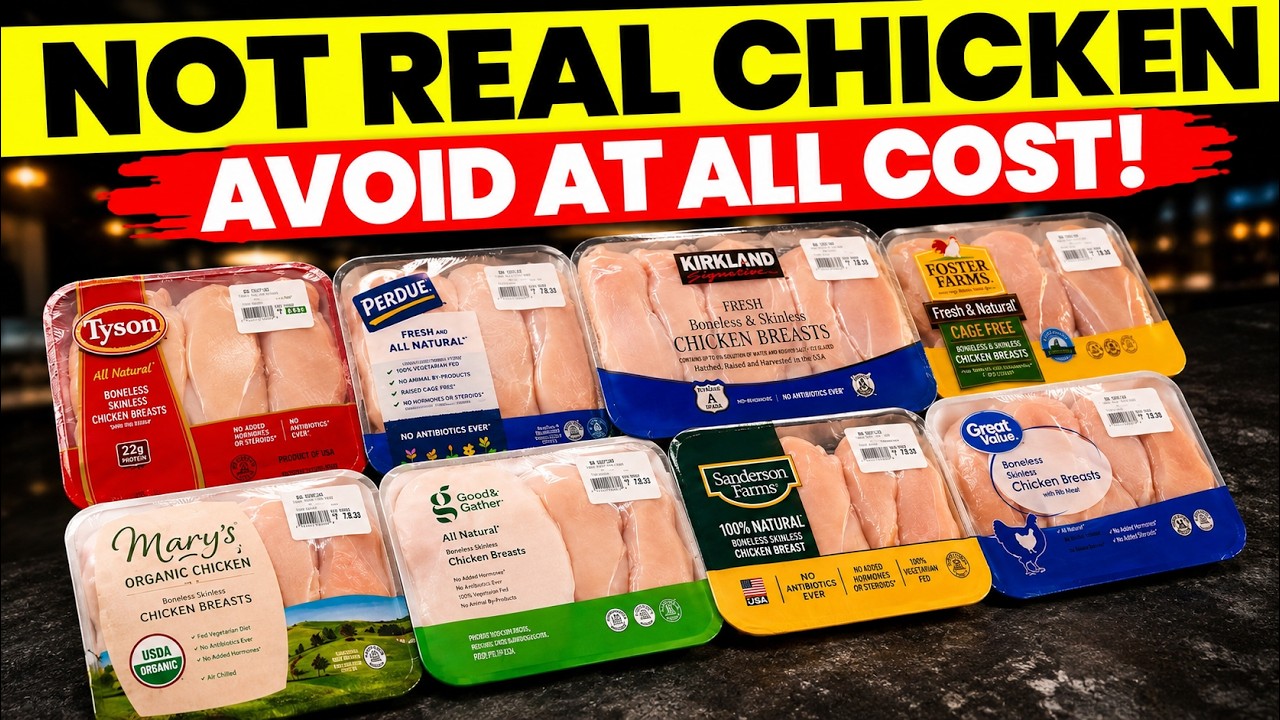
Thumbnail analysis
Pattern: Warning sign Trigger: Fear
Curiosity 6 · FOMO 2 · Pain 7 · Clarity 9
Text: NOT REAL CHICKEN AVOID AT ALL COST! · Face: no
Bold warning text combined with recognizable brand packaging triggers fear and distrust about a staple food, compelling viewers to find out which brands are unsafe.
Improvement: Circle or highlight the specific 'bad' chicken package to create a clearer curiosity hook and visual focal point.