How to Make Beef Incredibly Tender and Juicy in Minutes – The Chinese Secret Method!
Shufen's Kitchen · 121.3K views · 2026-07-29 · 197.2x outlier
Title analysis
How to Make {food} Incredibly {quality} in Minutes – The {cultural} Secret Method · novelty · tutorial
Cultural secret framing implies exclusive superior technique worth learning quickly.
Title features
14 words · question
Script
3117 words · 163 wpm · 19.1 min
Hook: You order beef and broccoli from the place down the road, $8. The beef is soft, it gives under your teeth, it is wet in the middle, and it slips apart. Then on Saturday, you buy a good piece of steak for $18... it comes out gray and chewy and dry.
Type / score: contrarian · 8/10
Structure: tutorial
Promise: full
Tone: intimate, authoritative, myth-busting, warm
Diagnosis: The script hooks hard with a relatable before/after failure story, builds authority through grandmother-persona and mechanistic explanation of why beef toughens, then delivers precise measurements and steps that fulfill the title's promise almost exactly at the midpoint, sustaining interest with myth-busting asides about marinades and crowded pans. Viewers most likely to drop off are those wanting the full recipe faster, since the science/backstory preamble runs long before the baking soda 'secret' is finally revealed, but retention should be strong throughout due to constant specificity and forward-teasing.
Full transcript with timestamps
00:00 You order beef and broccoli from the
00:02 place down the road, $8. The beef is
00:05 soft, it gives under your teeth, it is
00:07 wet in the middle, and it slips apart.
00:10 Then on Saturday, you buy a good piece
00:12 of steak for $18. You take it home, you
00:15 slice it, you cook it exactly the way
00:18 the recipe says, and it comes out gray
00:21 and chewy and dry and tastes like
00:23 something you have to work at. Better
00:26 meat, worse result. And you have spent
00:28 years blaming the cut or the pan or the
00:32 recipe or yourself. It is none of those.
00:35 That takeout beef was almost certainly a
00:38 cheap cut, cheaper than anything you
00:40 would put in your cart, and it was made
00:43 tender in 20 minutes by something that
00:45 costs about 4 cents. Every Chinese
00:48 restaurant in your town does it. Every
00:50 Chinese home cook does it. Almost nobody
00:53 outside those kitchens has ever been
00:55 told what it is. My name is Shufen. My
00:59 grandmother did this to every piece of
01:01 meat that came into her house, and she
01:04 did it without thinking, the way you
01:06 would rinse rice. There was a bowl, and
01:08 the meat went in the bowl, and it sat
01:11 while she cut the vegetables, and that
01:13 was simply what you did with meat before
01:15 it met a hot pan. It never occurred to
01:18 her that anybody did it differently. I
01:20 am going to give you the whole thing,
01:22 the one ingredient that does the real
01:24 work, which is already in your kitchen.
01:27 The exact amounts, because this is the
01:29 one place where too much is far worse
01:31 than too little. The step everybody
01:34 skips, that is the difference between
01:36 soft beef and wet, heavy restaurant
01:39 beef. And at the end, the part that will
01:41 change what you buy, because once you
01:43 can do this, the cheapest beef in the
01:45 store beats the expensive one. And I
01:48 will tell you exactly which cut to reach
01:51 for. But first, you have to understand
01:53 why beef goes tough, because once you
01:55 see it, everything after makes plain
01:58 sense. A muscle is bundles of long
02:01 fibers, and around and through them runs
02:05 connective tissue. When you put that
02:07 meat on heat, the proteins inside those
02:10 fibers start to change. They tighten,
02:13 they shorten, they pull in on themselves
02:16 like a hand closing into a fist. And
02:19 they are full of water, so as they
02:21 clench, that water is squeezed out, and
02:23 it runs into the pan, and it hisses and
02:26 steams away. And what is left in your
02:29 mouth is the fist, dry, tight, chewy.
02:32 That is all toughness is, proteins
02:34 clenching and ringing out their own
02:36 water, nothing else. So there are only
02:39 two ways to win. You either stop the
02:42 fist from closing so hard, or you get
02:44 the meat off the heat before it can. The
02:47 Chinese method does both at once, and it
02:49 takes about 25 minutes of waiting and
02:52 roughly 2 minutes of work. Now, the part
02:55 that should genuinely bother you,
02:57 because these are the things you have
02:58 been doing carefully on purpose,
03:01 believing they helped.
03:03 You marinate in something acidic, lemon
03:06 juice, vinegar, wine, pineapple, a
03:09 bottled marinade that is mostly acid,
03:12 and you leave it for hours because more
03:15 must be better. Acid does break proteins
03:19 down, that is true. But it also does the
03:22 thing you are trying to prevent, which
03:24 is that it makes the proteins on the
03:26 outside clench and squeeze water out. So
03:29 a long acid soak gives you meat that is
03:33 mushy and grainy on the surface and dry
03:36 underneath.
03:38 2 hours in a lemon marinade does not
03:40 tenderize a steak. It cooks the outside
03:43 of it and ruins the texture.
03:46 You buy your way out.
03:48 The recipe says the beef was chewy, so
03:51 next time you go up a grade and up
03:53 again, and now you are cooking a $22
03:56 piece of meat in a stir-fry, and it is
03:59 still not what the restaurant gave you,
04:02 because the problem was never the money.
04:04 And you crowd the pan. You put a whole
04:06 pound of beef into one skillet at once,
04:09 and it drops the temperature of that pan
04:11 instantly, and the meat sits there
04:14 releasing water until it is swimming in
04:16 it. That is not searing. That is boiling
04:19 meat in its own juice, and then the
04:22 water finally cooks off, and only then
04:24 does the meat start to brown, by which
04:27 time it is cooked through twice over.
04:29 That gray, weeping pan is the single
04:31 most common thing I see, and it is why
04:34 so many people believe they cannot cook
04:37 beef.
04:38 So, here is what a Chinese kitchen does
04:41 instead, and it happens in four moves.
04:44 Move one, and it is free. Cut the meat
04:47 correctly. Look at the piece of beef,
04:50 and you will see fine lines running
04:52 through it, all going the same
04:54 direction. Those are the fiber bundles.
04:57 If you cut along them, every piece on
04:59 your plate contains long, unbroken
05:02 fibers, and your teeth have to do all
05:05 the shearing. Cut across them at a right
05:08 angle to those lines, and the knife has
05:10 already done that work, and each fiber
05:12 in the mouth is a short stub. Same beef,
05:16 a different food.
05:18 And cut it thin,
05:19 about the thickness of two coins, an
05:22 eighth of an inch.
05:23 Thin against the grain is where half of
05:26 all tenderness comes from before you
05:28 have added a single thing. Here is how
05:31 you actually get slices that thin
05:33 without a professional knife. Put the
05:35 beef in the freezer for 20 to 30 minutes
05:38 first, until it is firm at the edges,
05:40 but not frozen through. Firm meat holds
05:44 still under the blade. Soft meat rolls
05:47 and squashes and you end up with wedges.
05:50 20 minutes in the freezer and even a
05:52 dull knife cuts like a good one. Slice
05:55 at an angle laying the knife over and
05:57 you get wider pieces that cook faster
06:00 still. Move two, and this is the secret
06:03 itself.
06:04 Baking soda, not baking powder. Baking
06:07 soda, the plain box in your cupboard,
06:10 the one you have used for cakes and
06:12 drains and the smell in the fridge. 4
06:15 cents worth of it does what an $18
06:17 upgrade at the meat counter cannot.
06:21 Here is why it works and it is
06:22 beautiful. Meat is slightly acidic.
06:26 Baking soda is alkaline, the opposite
06:28 end.
06:30 Coat the surface of the beef in a little
06:32 of it and you push the pH of that outer
06:35 layer up and at that higher pH the
06:37 proteins simply cannot bond to each
06:40 other as tightly. The fist cannot fully
06:43 close. So when the heat hits, the fibers
06:46 do not clench hard and they do not ring
06:48 themselves out and the water stays where
06:51 it was. The meat stays soft and stays
06:54 wet. That is the entire trick and it has
06:57 been in Chinese kitchens for
06:59 generations.
07:01 Now the amounts, and this is where I
07:02 need you to listen properly because this
07:05 is the one place on this whole channel
07:07 where more will hurt you.
07:09 Half a teaspoon of baking soda for 1 lb
07:12 of beef. That is it. Level, not heaped.
07:16 Too much and you will taste it and it is
07:18 not a small unpleasantness. It tastes
07:21 soapy and faintly metallic and it does
07:24 not cook away and the texture goes past
07:26 tender into something soft and slippery
07:29 and wrong like meat that has given up.
07:32 People try this once, use a big spoonful
07:35 because they want it to really work and
07:37 then decide the method is nonsense. It
07:40 is not the method, it is the spoon.
07:42 Weaker is better. Say it twice. Weaker
07:46 is better. Toss the sliced beef with
07:48 that half teaspoon until every piece has
07:50 some on it. Let it sit 15 to 30 minutes
07:54 at room temperature and do not go past
07:56 40 because past that the surface starts
07:59 to soften too far. Then rinse it
08:02 properly in a bowl of cold water, two
08:05 changes until the water runs clear. This
08:08 step is not optional and it is the one
08:10 people skip. The baking soda has already
08:13 done its work on the surface of the meat
08:15 and it does not need to be there anymore
08:18 and if you leave it, that is when you
08:20 taste it. Rinse it away and the
08:23 tenderness stays behind because the
08:25 change happened in the protein, not in
08:27 the coating. Then dry it, really dry.
08:31 Squeeze the beef in your hands over the
08:33 sink, then press it between paper towels
08:35 or a clean tea towel until the outside
08:38 is barely damp. Wet meat cannot brown.
08:41 Every drop you leave on it is a drop the
08:44 pan has to boil off before any cooking
08:46 begins and that is the difference
08:48 between beef that sears in 90 seconds
08:51 and beef that stews for 5 minutes. Move
08:54 three and this is the one that makes the
08:57 difference between soft beef and
08:59 restaurant beef. You are going to put
09:01 water into the meat on purpose. In a
09:05 Chinese kitchen, this has a name and it
09:07 is done to every piece of meat that goes
09:10 in a stir-fry and I have never once seen
09:12 it in a Western recipe.
09:15 Put the rinsed dry beef in a bowl. Add a
09:18 tablespoon of soy sauce and a tablespoon
09:20 of Shaoxing wine or dry sherry if that
09:23 is what you have. Then add three
09:25 tablespoons of cold water or cold stock,
09:28 but not all at once. A splash at a time
09:31 and after each splash you mix with your
09:34 hand, always stirring in one direction
09:36 and you keep going until the liquid has
09:39 vanished into the meat. It will vanish.
09:41 That is the strange part. Push it, and
09:44 the beef drinks it, and after a minute,
09:46 the bowl is not wet anymore. The meat is
09:49 just heavier and plumper and slightly
09:52 tacky in your fingers. You have put
09:54 water inside the muscle, and that is
09:57 water it will still have when it reaches
09:59 your plate. This is the reason
10:01 restaurant beef is juicy in a way home
10:04 beef never is, and it costs you 60
10:07 seconds. Then you lock it in.
10:10 1 Tbsp of cornstarch mixed through until
10:14 every piece is coated in a thin slick
10:16 paste.
10:18 An egg white, if you want it silkier
10:20 still, and for a stir-fry, I would.
10:24 And last of all, 1 Tbsp of oil stirred
10:28 through at the very end.
10:30 That order matters.
10:32 The cornstarch makes a soft jacket that
10:34 holds the water in and shields the meat
10:37 from the direct violence of the pan. So,
10:39 the outside does not overcook while the
10:42 inside catches up.
10:44 The oil goes on last because it stops
10:46 all the pieces from gluing themselves
10:48 into one lump and lets them slide loose
10:51 into the pan.
10:53 Put the oil in first, and the cornstarch
10:56 never sticks properly, and half your
10:58 coating ends up on the bottom of the
11:00 wok.
11:01 Let it sit at least 20 minutes now.
11:04 Half an hour is better, and it will
11:06 happily wait in the fridge overnight.
11:08 And honestly, overnight is best of all.
11:12 Move four,
11:13 the heat. And this is where people undo
11:16 everything they have just built. Get the
11:18 pan properly hot, hotter than feels
11:21 sensible.
11:23 A drop of water should skitter across it
11:25 and vanish, not sit and sizzle.
11:29 Add your oil, swirl it, and then work in
11:32 batches.
11:34 Half a pound of meat in the pan at most,
11:37 in one single layer with space between
11:39 the pieces.
11:41 Then leave it alone.
11:43 30 seconds without touching it.
11:45 Every time you stir, you drop the pan
11:48 temperature and you release more water.
11:51 And people stir constantly out of nerves
11:54 and end up with the gray weeping pan
11:56 again.
11:57 30 seconds still, then toss. Another 30
12:00 seconds and it is done.
12:03 90 seconds total.
12:05 Take it out of the pan while you still
12:07 think it might need a little longer
12:09 because it does not and it will carry on
12:12 cooking on the plate.
12:14 Cook your vegetables in the same pan.
12:17 Then at the very end, the beef goes back
12:19 in with the sauce for 15 seconds. Just
12:23 long enough to get hot and get coated
12:25 and off the heat and onto the table.
12:27 That is the whole method. Slice thin
12:30 against the grain.
12:32 Half a teaspoon of soda, 20 minutes,
12:35 rinse, dry.
12:37 Beat in the water, then cornstarch, then
12:40 oil.
12:42 Screaming hot pan, small batches, 90
12:45 seconds.
12:47 The mistakes that ruin it are few and
12:50 every one is avoidable.
12:52 Too much baking soda.
12:55 Not rinsing it off.
12:57 Not drying the meat afterwards.
13:00 Cutting along the grain instead of
13:02 across it.
13:04 Cutting too thick.
13:06 Putting the oil in before the
13:07 cornstarch.
13:09 Crowding the pan.
13:11 Stirring constantly.
13:14 Leaving it on the heat because it looks
13:16 underdone.
13:17 That is the entire list. And if your
13:20 beef disappoints you, it failed on one
13:22 of those and nine times out of of it was
13:25 the pan being too full or the soda being
13:28 too much.
13:30 And now the part that will change what
13:32 you put in your cart.
13:34 Once you can do this, the expensive cuts
13:36 become pointless for a stir-fry.
13:39 And I mean that plainly.
13:41 You are paying for tenderness, and you
13:43 can now create tenderness yourself for 4
13:46 cents. So, walk past the ribeye and the
13:49 sirloin and buy the cheap ones.
13:52 Flank steak,
13:54 skirt,
13:55 top round,
13:56 eye of round, which is one of the least
13:59 expensive things in the whole case, and
14:01 which nobody knows what to do with
14:03 because cooked as a steak, it is
14:05 genuinely tough.
14:07 Sliced thin against the grain and
14:10 treated this way, it comes out soft and
14:13 juicy and tastes far more of beef than a
14:16 mild expensive cut ever does because the
14:19 cuts that work hardest on the animal
14:21 have the most flavor in them.
14:23 That is why they are chewy in the first
14:25 place, and that is exactly the problem
14:28 we just solved.
14:29 This is worth real money.
14:32 Eye of round at five or six dollars a
14:34 pound against sirloin at 12 or ribeye at
14:38 22.
14:40 If you cook beef once a week, you will
14:42 save a few hundred dollars a year and
14:45 eat better while you do it. And it works
14:47 on more than beef. The same four moves
14:50 with a smaller pinch of soda make
14:52 chicken breast soft instead of stringy
14:55 and pork loin and the tough parts of
14:57 lamb.
14:58 Chicken needs less, about a quarter
15:01 teaspoon a pound, and less time, 15
15:04 minutes.
15:05 Fish needs none of it at all, only the
15:08 cornstarch, because fish has nothing
15:10 like that structure to fight.
15:13 Now, let me say the plain thing about
15:15 why nobody told you.
15:17 Walk to the meat counter and look at how
15:19 tenderness is sold to you.
15:21 Grades and names and marbling and price
15:24 per pound. And every step up that ladder
15:27 costs more.
15:28 And the whole ladder exists because
15:30 tender meat is the thing people will pay
15:32 for.
15:34 That is a real difference and I am not
15:36 saying it is a lie.
15:38 But it is a difference you are buying
15:40 when for most of the ways you cook at
15:42 home, you could simply make it. Look on
15:44 the shelf beside the spices and you will
15:46 find the other version of this.
15:49 A shaker of meat tenderizer, four or
15:51 five dollars. And what is in it is
15:54 usually an enzyme from papaya or
15:56 pineapple that chews the proteins apart.
16:00 It works in the sense that the meat gets
16:02 softer and it keeps working while it
16:04 sits and it does not know when to stop.
16:07 So meat left in it too long goes soft
16:09 and mealy and slightly rotten in
16:12 texture.
16:13 They sold you the harsher version of a
16:15 thing you already own for four cents a
16:17 spoonful. I do not think there is a
16:20 wicked man in a back room.
16:22 It is duller and sadder than that.
16:25 There is money in the upgrade from round
16:27 to sirloin to ribeye.
16:30 There is money in a shaker with a label.
16:32 There is no money at all in the box of
16:35 baking soda you bought for the fridge in
16:37 a year you cannot remember.
16:39 Nobody films a commercial for half a
16:41 teaspoon of it.
16:43 No salesman knocks on your door to tell
16:45 you the cheapest beef in the case will
16:47 beat the most expensive one if you give
16:49 it 20 minutes and a bowl of water.
16:53 So here is what I would have you do this
16:54 week.
16:55 Buy the cheap cut.
16:57 Eye of round or flank, whichever is
17:00 lower.
17:01 20 minutes in the freezer, then slice it
17:03 thin across the grain at an angle.
17:07 Half a teaspoon of baking soda to the
17:09 pound.
17:10 20 minutes.
17:11 Rinse it well in two changes of water
17:14 and dry it properly.
17:16 Soy, wine,
17:18 then 3 Tbsp of water beaten in a splash
17:21 at a time until it is gone.
17:24 Then a tablespoon of cornstarch.
17:26 Then a tablespoon of oil last.
17:29 Rest it half an hour.
17:31 Screaming hot pan, half a pound at a
17:34 time,
17:35 30 seconds untouched, toss, 30 more, and
17:39 out.
17:40 Vegetables next. Beef back in at the end
17:42 for 15 seconds with the sauce.
17:45 And when you sit down and eat it, notice
17:47 what happened because it will be the
17:49 first time your own beef has done what
17:52 the takeout beef does. And you will find
17:54 that the difference was never the pan
17:56 and never the money.
17:59 Tell me in the comments what cut you
18:00 tried it on and what you paid a pound
18:02 for it because I am always curious what
18:05 beef costs where you are and it is
18:07 different everywhere.
18:09 And tell me whether you were a lemon
18:11 marinade person or an expensive cut
18:14 person.
18:15 Because it is nearly always one or the
18:17 other and neither of you was doing
18:19 anything foolish.
18:21 The stories you leave will teach the
18:23 next person far more than I ever could.
18:26 And I read every single one.
18:28 Next time, since we are on making cheap
18:31 meat taste like money, I am going to
18:33 show you the pot my grandmother kept and
18:35 never once emptied. A dark spiced liquid
18:39 that meat goes into and comes out of and
18:42 that is topped up and used again and
18:44 again for years, for decades, and in
18:47 some families for more than a hundred so
18:50 that a piece of it is handed to a
18:51 daughter when she marries.
18:54 It is the deepest flavor in Chinese
18:56 cooking and it costs almost nothing to
18:58 start. And you can begin yours on a
19:00 Sunday afternoon.
19:02 That one is next.
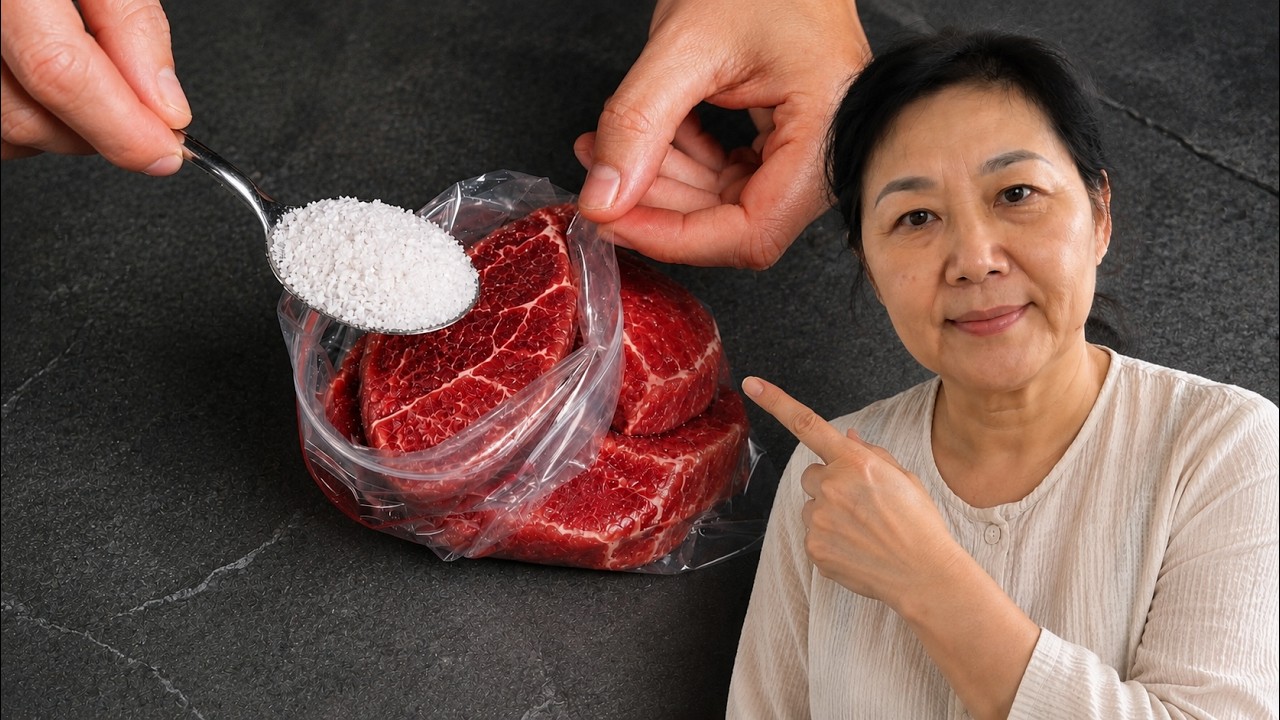
Thumbnail analysis
Pattern: Object closeup Trigger: Curiosity gap
Curiosity 6 · FOMO 1 · Pain 6 · Clarity 8
Text: none · Face: yes
The mystery white powder being sprinkled on raw meat combined with a confident pointing woman creates a curiosity gap about a 'secret' technique, reinforced by the authority/cultural framing of a 'Chinese Secret Method'.
Improvement: Add bold on-image text like 'Secret Ingredient?!' to reinforce the curiosity hook for viewers scrolling quickly.