I'm Not Buying Oxtails Anymore —This Old HARLEM Butcher Trick Gets Twice the Meat for Half the Price
Backyard Reggie · 1.3M views · 2026-08-24 · 118.2x outlier
Title analysis
I'm Not {activity} Anymore — This Old {regional} {expert} Trick Gets {benefit} · greed · reveal
Value-maximizing insider trick combines savings and authority for practical appeal.
Title features
18 words ·
Script
2142 words · 189 wpm · 11.3 min
Hook: There's a butcher shop up in Harlem that's been in the same family for three generations... He walked me straight to a completely different case in the back of his shop and said, 'Come here. Let me show you what we used to actually cook before oxtail turned into a specialty item everybody suddenly wanted.'
Type / score: story_scene · 7/10
Structure: hybrid
Promise: full
Tone: warm, folksy, instructive, nostalgic
Diagnosis: The butcher-shop frame story and clear promise (twice the meat, half the price) hook viewers early and the step-by-step cooking section keeps specificity high, which should sustain retention through the tutorial middle. However the heavy filler music tags, repetitive phrasing, and a slow, single-register delivery in the back half risk losing viewers who wanted a snappier payoff after the setup's strong tease.
Full transcript with timestamps
00:00 There's a butcher shop up in Harlem
00:01 that's been in the same family for three
00:03 generations, and the man who runs it now
00:06 learned to cut meat from his father, who
00:08 learned from his father before that. And
00:10 the first time I asked him why oxtail
00:12 prices had climbed the way they have
00:14 over the last several years, he didn't
00:16 just complain about it the way I
00:17 expected.
00:19 He walked [music] me straight to a
00:20 completely different case in the back of
00:22 his shop and said, "Come here. Let me
00:25 show you what we used to actually cook
00:26 >> [music]
00:27 >> before oxtail turned into a specialty
00:29 item everybody suddenly wanted." And
00:30 what he showed me changed how I shop for
00:32 that whole category of soul food cooking
00:34 [music] completely. Today, I want to
00:36 walk you through what he taught me,
00:38 why oxtail got so expensive in the first
00:40 place,
00:41 what the old alternative actually is,
00:43 why it generally gives you more usable
00:45 meat for less money, and exactly how to
00:47 cook it so it comes out every bit as
00:49 rich and tender as the oxtail dish you
00:51 grew [music] up eating.
00:53 Let's start with the oxtail situation
00:55 itself, because understanding why it got
00:57 expensive is really what makes the
01:00 alternative make sense in the first
01:01 place.
01:02 Oxtail used to be, and I mean this
01:05 literally, considered [music] a
01:06 throwaway cut.
01:08 It's the tail of the cow, a small amount
01:10 of actual meat wrapped around a series
01:12 of [music] bony vertebrae. And for most
01:14 of American culinary history, it was
01:16 priced accordingly, cheap, sometimes
01:19 nearly given away by butchers who had
01:21 more of it than anyone [music]
01:22 particularly wanted. Soul food cooking,
01:25 Caribbean cooking, a lot of global
01:27 culinary traditions built entirely
01:29 around [music] stretching tougher, less
01:30 desirable cuts into something incredible
01:33 through long, slow cooking, embraced
01:35 oxtail specifically because it was both
01:38 cheap and once you actually understood
01:40 how to [music] cook it, genuinely
01:41 delicious, loaded with collagen and
01:44 connective tissue that breaks down into
01:46 rich, [music] gelatinous goodness over
01:47 hours of low heat.
01:49 But over the last decade or so, oxtail
01:52 went through a real transformation in
01:54 the marketplace.
01:56 It got essentially discovered by a much
01:59 wider audience. [music] Restaurants
02:00 started featuring it prominently.
02:02 It started showing up on trendy menus,
02:04 [music]
02:05 and demand shot up dramatically.
02:07 While the actual supply, remember,
02:09 there's only one tail per cow,
02:11 stayed exactly [music]
02:13 as limited as it's always been.
02:15 Basic supply and demand did the rest.
02:17 What used to be a cheap, overlooked cut
02:19 is now, in [music] a lot of markets,
02:20 priced closer to a premium item,
02:22 sometimes rivaling or even exceeding the
02:24 price of actual steak cuts per pound,
02:27 which is genuinely wild when you think
02:29 about what it actually is anatomically.
02:31 So, the old Harlem butcher's point was
02:33 simple.
02:34 If the [music] entire appeal of oxtail,
02:36 for people who grew up loving it, was
02:37 never really about the specific bones
02:39 themselves,
02:40 >> [music]
02:40 >> it was about that rich, falling apart,
02:43 deeply gelatinous texture and flavor
02:45 that comes from long cooking a
02:47 collagen-heavy [music] cut,
02:49 then there are other parts of the cow
02:50 that deliver that exact same experience
02:53 at a fraction of the price, because they
02:56 haven't been discovered and marked up
02:57 the same way yet.
02:59 And the specific [music] cut he pointed
03:00 me toward was beef neck bones,
03:03 sometimes just called neck.
03:05 Occasionally, you'll see it labeled as
03:06 beef neck rings, [music]
03:08 depending on how the butcher's cut it.
03:10 This is one of those cuts that stayed
03:11 genuinely [music] cheap, still priced
03:13 the way oxtail used to be priced,
03:15 because it hasn't caught on with the
03:16 wider audience the same way.
03:18 It's still mostly known within the exact
03:21 same soul [music] food and traditional
03:22 cooking communities that have been using
03:24 it for generations,
03:26 quietly, without it ever becoming
03:28 trendy.
03:28 >> [music]
03:29 >> Let's talk about why neck bones work so
03:31 well as a genuine substitute, because
03:33 it's not just that they're [music]
03:35 cheap. There's a real structural and
03:37 culinary logic here.
03:39 Anatomically, the neck is [music] doing
03:41 an enormous amount of work on a living
03:42 animal,
03:43 supporting the head,
03:45 constantly moving,
03:46 >> [music]
03:46 >> which means it's absolutely loaded with
03:48 connective tissue and collagen,
03:51 the exact same category of tissue that
03:53 makes oxtail so rich when it's cooked
03:55 low and slow.
03:56 This isn't a lean, tender muscle like a
03:58 fillet. It's dense, tough, and full of
04:00 exactly the kind of tissue that needs
04:02 hours of gentle heat to transform, which
04:05 is precisely the profile you want for
04:07 this style of cooking.
04:08 You're not looking for tenderness
04:09 straight out of the package, you're
04:11 looking for the raw material that
04:12 becomes tender through the cooking
04:13 process itself.
04:15 And here's the detail that really got
04:17 me, the twice the meat part of what he
04:19 was telling me.
04:21 Oxtail, per pound, [music]
04:23 is mostly bone and connective tissue
04:25 relative to actual usable meat because
04:27 of how the tail is structured. Small
04:29 rings of vertebrae with a modest amount
04:31 of meat wrapped around each one.
04:34 Neck bones, per pound, [music] generally
04:36 carry a noticeably higher ratio of
04:37 actual meat to bone because the neck
04:40 itself is a thicker, more substantial
04:42 structure than the tail. So, you're not
04:43 just paying less per pound, [music]
04:45 you're also getting more actual usable
04:47 meat out of that same pound once it's
04:49 cooked down and you're picking it off
04:51 the bone, which is where that twice the
04:53 meat framing genuinely holds up.
04:55 >> [music]
04:55 >> It's not just a catchy way of putting
04:57 it, there's real substance behind that
04:59 comparison.
05:00 >> [music]
05:01 >> Now, let's get into how to actually cook
05:02 these because the old Harlem approach is
05:06 almost identical to how you'd approach
05:08 oxtail, [music]
05:09 just with a few adjustments worth
05:10 knowing about.
05:12 First, the trim and prep.
05:15 Neck bones sometimes come with a bit
05:16 more surface fat than you'd find on
05:18 oxtail,
05:19 so I trim any large, thick sections of
05:21 hard exterior fat, leaving smaller
05:23 pockets of it alone, since that's going
05:25 to render down and contribute to the
05:27 richness of the final dish.
05:29 Same logic as trimming a brisket.
05:30 [music]
05:31 I give them a good rinse and pat them
05:33 dry because a dry surface browns
05:35 properly. A wet one just steams.
05:38 Second, the sear.
05:40 And this step is not optional if you
05:41 actually want the depth of flavor this
05:43 dish is capable [music] of.
05:45 I season the neck bones generously,
05:47 salt, pepper, garlic [music] powder,
05:49 onion powder, and brown them in batches
05:51 in a heavy pot. Not crowding the pot.
05:55 The same Maillard principle I've talked
05:57 about across basically [music] every
05:58 video on this channel. That hard sear is
06:01 building a genuine flavor foundation you
06:03 simply [music] don't get if you skip
06:05 straight to simmering everything from
06:07 raw.
06:08 Third, [music] the aromatic base. And
06:10 this is where the dish really starts to
06:13 smell like the soul food kitchens a lot
06:15 of us grew up around.
06:16 >> [music]
06:16 >> Onion, bell pepper, celery, sometimes
06:19 referred to as the holy trinity in a lot
06:21 of southern and [music] soul food
06:23 cooking traditions. Sautéed in the same
06:25 pot, picking up all that fond left
06:28 behind from searing [music] the meat.
06:30 Garlic goes in after, along with bay
06:32 leaves, thyme, a good amount of black
06:34 pepper, and depending [music] on how I'm
06:36 feeling that day, a bit of smoked
06:37 paprika or even a touch of allspice,
06:41 which shows up in a lot of Caribbean
06:42 influenced versions [music] of this
06:44 style of cooking and adds a really
06:45 distinctive warmth.
06:47 Fourth, [music] the braising liquid, and
06:49 I keep this relatively simple, beef
06:51 stock. Sometimes a splash of
06:53 Worcestershire for depth.
06:55 Sometimes [music]
06:56 a bit of tomato paste stirred in for
06:58 body and a subtle acidity that helps
07:00 balance all [music] that richness. The
07:02 meat goes back in. Everything gets
07:05 brought up to a simmer, and then this is
07:07 the important part, it goes down to a
07:09 low gentle simmer, not a hard boil, and
07:12 it stays there. Covered for a real
07:14 stretch of time. Generally somewhere in
07:16 the 2 and 1/2 [music] to 3-hour range.
07:18 Sometimes longer depending on the exact
07:20 size of the pieces you're working with.
07:23 You're looking for the exact same visual
07:24 [music] and textural cues you use with
07:26 oxtail.
07:27 Meat that's pulling away from the bone
07:29 with almost no resistance. A rich,
07:32 slightly [music] thickened braising
07:33 liquid from all that collagen breaking
07:35 down and dissolving into it, and that
07:37 deep dark color that only comes from
07:39 hours of low, slow [music] cooking, not
07:41 something you can rush by cranking the
07:43 heat.
07:44 Fifth, and I think this is genuinely
07:46 important, don't [music] skip the
07:47 resting and settling time at the end.
07:49 I like to let the pot sit off the heat
07:52 for a good 20 or 30 minutes once it's
07:54 done cooking.
07:55 Sometimes even longer before serving.
07:58 Because [music] that gelatinous braising
08:00 liquid actually continues to develop and
08:02 settle a bit as it cools slightly. And
08:04 honestly, like a lot of the long cooked
08:06 dishes I've talked about on this
08:07 channel,
08:08 this whole thing is even better the next
08:10 day.
08:11 Once it's had a full night in the fridge
08:13 for everything to melt together
08:15 completely.
08:16 Serve it the exact same way you'd serve
08:18 oxtail over rice,
08:20 letting that rich braising liquid soak
08:22 down into it alongside whatever sides
08:24 you traditionally pair with oxtail in
08:26 your own household.
08:27 >> [music]
08:27 >> Because honestly, once this is done, the
08:30 final dish is remarkably close in
08:31 character, in richness, [music] and that
08:34 deep falling apart texture to what you
08:36 get from actual oxtail
08:38 at a genuine [music] fraction of the
08:39 cost.
08:40 I want to be honest about where the
08:42 differences actually are because I don't
08:44 want to oversell this as an identical
08:46 one-for-one [music] replacement in every
08:48 single way.
08:49 The specific bone shape is obviously
08:51 different. Oxtail has that distinctive
08:53 vertebral structure that some people
08:54 specifically enjoy working around while
08:56 eating. And neck [music] bones have
08:58 their own bone structure that's a bit
09:00 different to navigate.
09:02 There's a slightly different meat to
09:03 [music] fat ratio between the two cuts
09:05 as well.
09:06 Though I'd argue that's honestly part of
09:08 what makes neck bones give you more
09:09 usable meat in the first place.
09:11 >> [music]
09:11 >> But in terms of overall flavor profile,
09:14 richness,
09:15 and that deeply satisfying falling off
09:17 the bone texture that's really the whole
09:18 point of cooking a dish like [music]
09:20 this,
09:21 they're remarkably close. Close enough
09:23 that a lot of people, myself included
09:25 the first time [music] he had me taste
09:26 his version blind, genuinely can't tell
09:29 the difference without being told
09:30 beforehand.
09:31 The broader lesson here, and I think
09:33 this is really what stuck with me most
09:34 after that whole conversation in his
09:36 shop,
09:37 is one I keep [music] coming back to
09:39 across a lot of these videos that a huge
09:41 amount of what makes a cut special or
09:43 [music] expensive isn't really about the
09:45 meat itself. It's about what's currently
09:47 trendy, what's currently being featured
09:49 on menus and social media, [music]
09:51 and what's fallen out of everyday
09:52 household use over the last generation
09:54 or two.
09:55 >> [music]
09:55 >> The actual cooking techniques that make
09:57 a tough, collagen-heavy cut incredible,
10:00 the low and slow heat, the proper sear
10:02 beforehand, the aromatic base,
10:05 all of that transfers completely and
10:07 directly across a whole range of cuts
10:08 that most [music] people have simply
10:10 stopped thinking about because they've
10:12 been trained by rising prices and food
10:14 trends to reach [music] for one
10:16 specific, now expensive item instead of
10:18 understanding the actual underlying
10:20 principle behind why that item was good
10:22 to begin [music] with.
10:24 If you try this, and I genuinely hope
10:26 you do, look specifically for beef neck
10:28 bones at a real butcher counter rather
10:30 than a prepackaged supermarket shelf if
10:33 you can manage it, because that's
10:34 generally where you're going to find the
10:36 best price and the freshest product. The
10:39 same advice I'd give for basically any
10:41 of these less mainstream cuts I've
10:42 talked about across [music] this
10:43 channel. And don't be shy about asking
10:45 your butcher directly if oxtail feels
10:47 out of reach
10:49 price-wise these day. A lot of them,
10:51 like the man who taught me all of this,
10:53 are genuinely happy to point you toward
10:54 the older, cheaper cut that used to do
10:57 exactly the same job in kitchens for
10:58 generations before oxtail [music]
11:00 ever became what it is today.
11:03 Let me know in the comments if you grew
11:04 up eating neck bones in your own
11:06 household because I have a feeling
11:08 there's a real generational split in
11:10 this comment section.
11:12 Some of you have been doing this the
11:13 whole time [music] and are wondering
11:14 what took the rest of us so long to
11:16 catch up.
11:17 Thanks for watching, and I'll see you in
11:19 the next one.
Thumbnail analysis
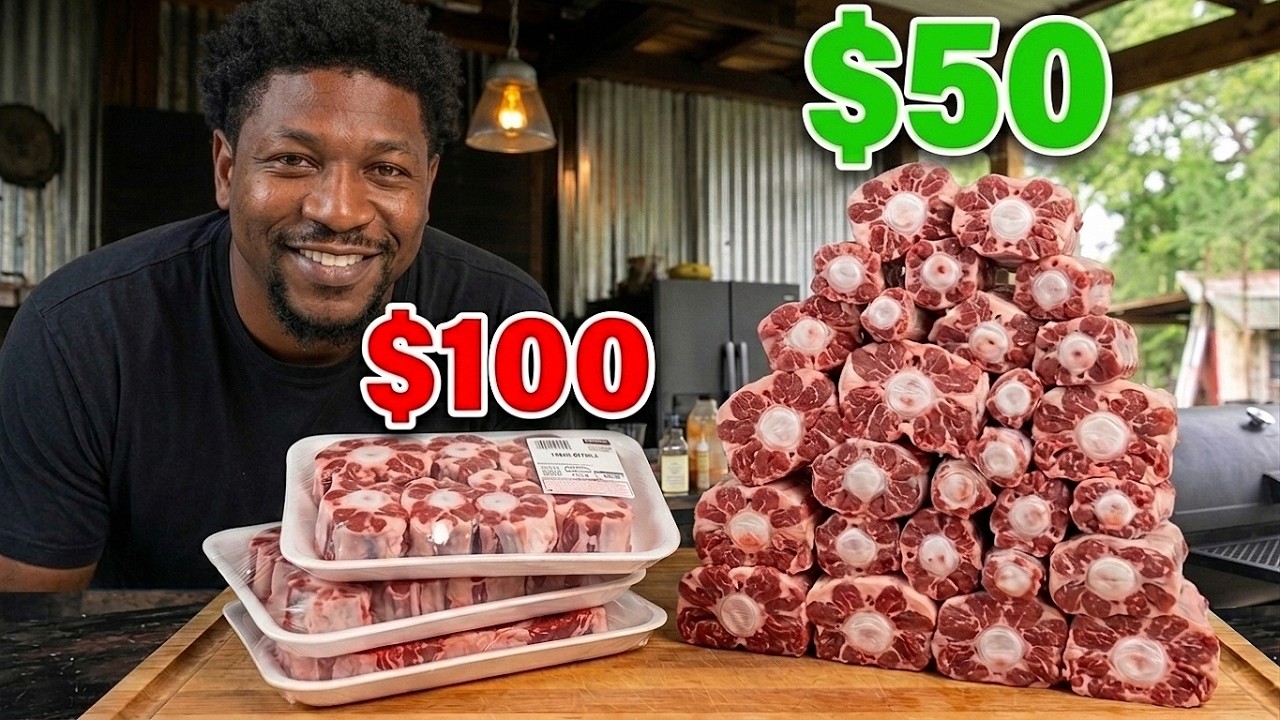
Pattern: Comparison split Trigger: Greed
Curiosity 6 · FOMO 3 · Pain 6 · Clarity 9
Text: $100 $50 · Face: yes
Direct price comparison with a visibly larger pile for less money triggers greed and curiosity about the trick that achieves it.
Improvement: Make the price disparity even more visually obvious by enlarging the $50 pile further or adding an arrow highlighting the size difference.