15 US Coffee Brands to Avoid — And 5 That Are Actually Real Coffee
Brand Uncovered · 924.4K views · 2026-08-08 · 113.4x outlier
Title analysis
{N} {category} Brands to Avoid — And {M} That Are Actually {quality} · pain_point · list
Warning plus reward structure gives both a threat to avoid and a solution to seek.
Title features
13 words · number
Script
4421 words · 150 wpm · 29.5 min
Hook: Every morning you make coffee without thinking twice. But after this video, you will.
Type / score: warning · 8/10
Structure: list
Promise: full
Tone: investigative, authoritative, ominous, methodical
Diagnosis: The script hooks hard with a warning about a daily habit and sustains momentum through court filings, lab data, and corporate ownership reveals that consistently escalate stakes, which should hold viewers through most of the runtime. Risk of drop-off comes mid-list where the pattern (lawsuit/ownership/sourcing gap) becomes repetitive despite varied specifics, and only the recommendation section near the end fully resolves the 'real coffee' half of the title's promise.
Full transcript with timestamps
00:00 Every morning you make coffee without
00:01 thinking twice. But after this video,
00:04 you will.
00:05 >> [music]
00:05 >> We checked the ingredient lists, the
00:07 court filings, the lab results, the
00:10 ownership behind the labels. What we
00:12 found across 15 of the most trusted
00:14 coffee brands in America is not what
00:16 most people expect. Serving counts that
00:19 don't [music] add up. A product that's
00:21 barely 8% coffee. Three household names
00:24 made in the same factory sold at three
00:26 different prices. And the brand built on
00:29 being the cleanest [music] option, the
00:31 evidence tells a very different story.
00:33 15 brands,
00:34 >> [music]
00:34 >> ranked worst to first. Let's go.
00:37 Number 15. Great Value Ground Coffee.
00:41 We start here because Great Value is at
00:43 least honest about what it is. And even
00:46 that honesty leaves a lot out. Walmart's
00:48 store brand coffee sits at the absolute
00:50 floor [music] of the American market.
00:52 The label tells you there's a blend of
00:54 Arabica and Robusta [music] beans
00:56 inside, pre-ground, sealed in a
00:58 canister. What it won't tell you, which
01:01 countries [music] those beans came from,
01:03 when they were roasted, or who actually
01:05 made it. That Robusta content matters
01:07 more than most shoppers realize. Arabica
01:10 grows at high altitude, matures slowly,
01:12 [music]
01:13 and develops the compounds that make
01:15 quality coffee taste like something.
01:17 Robusta grows fast, hits harder on
01:19 caffeine, and brings a rubbery [music]
01:21 bitterness blenders work to mask. A
01:23 Robusta blend isn't fraud. Robusta is a
01:26 legitimate coffee species.
01:28 But the cheapest Robusta comes from
01:30 regions with the loosest quality
01:32 controls.
01:33 That's where the risk [music] lives.
01:35 Immature beans, processing defects, and
01:38 undisclosed filler material entering the
01:40 supply chain.
01:41 And it's not theoretical. Peer-reviewed
01:44 research has confirmed [music] corn,
01:46 barley, wheat, soy, coffee husks,
01:49 caramelized sugar, chicory, and woody
01:51 plant tissue inside products labeled as
01:53 coffee.
01:54 Walmart generated over $611
01:58 in revenue last year. Printing the
02:00 country of origin on a canister is not a
02:02 financial challenge. [music] It's a
02:04 decision.
02:05 The can tells you coffee is inside.
02:08 Everything else, which coffee, from
02:10 where, roasted when, [music] is left
02:12 blank.
02:13 Number 14, Maxwell House Original Roast.
02:17 Maxwell House [music] has been an
02:18 American home since 1892.
02:21 Tied to Theodore Roosevelt,
02:23 >> [music]
02:23 >> the kind of brand that feels permanent.
02:25 Credit where it's due. In 2007, Maxwell
02:29 House genuinely improved. It dropped
02:31 robusta and switched to 100% Arabica.
02:35 That was a real change. The problem
02:37 isn't the bean type, it's what the
02:39 sourcing system behind that Arabica
02:41 claim can't confirm. Kraft Heinz owns
02:43 Maxwell House, over $26 billion in
02:47 revenue in fiscal 2024. The beans come
02:50 from multiple countries [music] through
02:52 a commodity procurement system. No
02:54 country percentages, no farm
02:56 relationships,
02:57 >> [music]
02:57 >> no public quality grading. Here's why
03:00 that matters. Arabica is a species, not
03:03 a quality standard. Arabica beans grown
03:06 at low altitude, picked immature, dried
03:08 improperly, [music]
03:09 still technically Arabica, also
03:11 vulnerable to ochratoxin A, a mold
03:14 compound produced by Aspergillus and
03:16 Penicillium [music] that grows on poorly
03:18 handled beans during storage. Toxic to
03:21 the kidneys at sufficient exposure. The
03:23 EU caps ochratoxin A in roasted [music]
03:25 coffee at 3 micrograms per kilogram. The
03:28 United States has no equivalent limit.
03:31 Coffee [music] that would be destroyed
03:32 in Europe can legally sit on an American
03:35 shelf with zero consumer notification.
03:37 That's not a footnote. That's the
03:39 difference between legal and illegal,
03:41 [music] depending on which country
03:42 you're in. On top of that, Maxwell House
03:45 faces a class action lawsuit filed in
03:47 the Western [music] District of
03:48 Pennsylvania in 2020. The number of
03:51 servings on the canister is allegedly
03:53 overstated. Kraft Heinz has denied it.
03:56 Still unresolved. Good to the last drop.
03:59 Whether those drops match what's on the
04:01 label is a question the courts are
04:02 currently answering.
04:04 Number 13, Folgers Classic Roast. Number
04:08 one selling ground coffee in America
04:10 since the 1990s. Over a century on
04:13 shelves. J.M. Smucker, which also owns
04:16 Jif and Crisco, acquired it from Procter
04:19 & Gamble in 2008. In July 2024, class
04:23 certification was granted in the Western
04:25 District of Missouri against Smucker and
04:27 Folgers. The allegation, Folgers falsely
04:30 advertises how many servings its coffee
04:33 produces. A Missouri class was certified
04:36 covering purchases from August 2015 to
04:38 present. Appeals reached the 8th Circuit
04:41 in November 2025.
04:42 >> [music]
04:43 >> The claim is simple. Brew Folgers at the
04:45 serving size on the label, you don't get
04:48 the [music] cup count the label
04:49 promises. Folgers has denied everything
04:52 and is contesting the case. 130 years on
04:55 the market.
04:56 >> [music]
04:56 >> The most popular ground coffee in
04:57 America. A class-certified lawsuit about
05:00 whether the number on the can means what
05:02 it says.
05:03 Three brands in a row. Great Value,
05:06 Maxwell [music] House, Folgers. Each
05:09 either facing a lawsuit about the
05:11 serving count, hiding their sourcing, or
05:13 both.
05:14 Different companies, [music]
05:15 different courts, same pattern. The cup
05:18 count on any pre-ground canister is
05:20 [music] worth treating as an estimate,
05:22 not a promise.
05:24 Number 12, Nescafe [music] 3 in 1
05:26 instant coffee. Don't read the front,
05:29 flip it over. The actual ingredient list
05:31 in order, sugar, glucose syrup, hardened
05:35 palm [music] oil, instant coffee 7.9%,
05:39 caramelized sugar, stabilizers, milk
05:42 proteins, salt, maltodextrin,
05:44 emulsifier, flavoring. Coffee is the
05:47 fourth ingredient, less [music] than 8%
05:50 of the product by weight. Over 92% is
05:52 sugar, corn syrup, palm oil, more sugar,
05:56 stabilizer, salt, and filler. [music]
05:58 This isn't coffee with added
05:59 convenience. It's a sugar and fat
06:01 product with just enough coffee to
06:03 justify [music] the name on the packet.
06:05 Try it yourself. Dissolve a three-in-one
06:08 and any plain instant coffee in equal
06:10 hot water. [music]
06:11 The three-in-one tastes richer and more
06:13 satisfying. That's not better coffee.
06:15 [music] That's the glucose syrup, palm
06:17 oil, and maltodextrin doing exactly what
06:20 they were engineered [music] to do. The
06:22 flavor is real. The coffee producing it
06:24 is not. Nestlé reported approximately 91
06:28 billion Swiss francs in revenue in
06:30 fiscal [music] 2024. Putting more coffee
06:32 in this product isn't a technical
06:34 problem.
06:34 >> [music]
06:35 >> It's a margin decision.
06:37 Number 11. Duncan packaged ground
06:39 coffee. Here's the fact that changes how
06:42 you see the entire [music] coffee aisle.
06:45 The Duncan packaged ground coffee at
06:47 Kroger, Walmart, and Target is
06:49 manufactured by J.M. Smucker, the same
06:52 company that makes Folgers. Not similar,
06:54 the same. The Duncan logo is a licensing
06:57 arrangement. [music] Smucker pays for
06:58 the right to print that branding on a
07:00 bag. Inside, 100% Arabica coffee, no
07:04 country of origin,
07:05 >> [music]
07:05 >> no roast date, no farm sourcing.
07:08 Identical to every other Smucker product
07:11 because it is [music] one. Duncan sits
07:13 at a higher price than Folgers on the
07:15 same shelf. Same manufacturer, same
07:17 supply chain, different logo, different
07:20 [music] price. The premium is entirely
07:22 for brand association. Nothing in the
07:24 bag justifies [music] it. Buy both on
07:26 the same trip. Brew them at the same
07:28 ratio. Taste them without looking. Most
07:31 people can't tell them apart. The main
07:33 variable is usually which one you tasted
07:35 [music] first. The extra money on the
07:37 Duncan bag is a licensing fee paid to a
07:39 donut company. That's the whole story.
07:43 Number 10, [music] McCafe ground coffee.
07:45 Same story, different logo.
07:48 >> [music]
07:48 >> Packaged McCafe on grocery shelves is
07:50 manufactured by J.M. Smucker under a
07:53 licensing deal with McDonald's. 100%
07:56 Arabica on the label. No [music] origin,
07:59 no roast date, no farm sourcing.
08:01 Identical omissions to Folgers and
08:03 Dunkin. Same operation. [music]
08:05 Folgers, Dunkin, McCafe. Three
08:07 completely different looking brands at
08:09 three different price [music] points.
08:11 All the same product from the same
08:12 manufacturer. McDonald's reported nearly
08:15 $25 billion in revenue in fiscal 2024.
08:19 Smucker over $8 billion. Both profit
08:22 from the arrangement. A different cup of
08:24 coffee is not what either party is
08:26 delivering.
08:27 If this is already changing how you read
08:29 labels, [music] go ahead and like the
08:31 video. Helps more people find this
08:33 before their next grocery run.
08:36 The ownership picture most people never
08:38 see. Folgers, Dunkin, [music] McCafe.
08:41 All Smucker. Maxwell House, Kraft Heinz.
08:44 8 O'Clock and Green Mountain, both
08:46 coming up. Both Keurig Dr. Pepper. The
08:49 coffee aisle looks competitive. The
08:51 ownership map underneath it is a handful
08:53 of corporations. When a conglomerate
08:56 buys a coffee brand, distribution
08:58 scales. Transparency doesn't.
09:01 Number nine, [music]
09:02 Kirkland Signature ground coffee.
09:04 Different from everything above it and
09:06 still on the list. Kirkland Signature
09:08 Organic is [music] USDA certified
09:11 organic and roasted by Starbucks under
09:13 contract for Costco. Documented,
09:16 verified. On sourcing, [music] genuinely
09:19 better than anything Smucker or Kraft
09:21 Heinz produces. The problem isn't the
09:23 beans. [music] It's what happens between
09:25 grinding and the moment you open the
09:27 bag. Ground coffee degrades from the
09:29 second it's ground. The aromatic
09:31 compounds responsible for everything
09:33 coffee smells and tastes like begin
09:35 escaping immediately. A 2 and 1/2 lb bag
09:38 at a warehouse club was ground [music]
09:40 weeks, sometimes months before you
09:42 opened it. The nitrogen flush slows
09:45 that. It doesn't reverse it.
09:46 >> [music]
09:47 >> Quick test. Open a fresh Kirkland bag
09:49 and smell it. Reseal it. Leave it 12
09:52 hours. Smell [music] it again. That drop
09:54 in aroma over half a day reflects what
09:56 already happened during the weeks
09:58 between grinding and your shelf. For a
10:00 two adult household at two cups a day,
10:03 that bag lasts six to [music] eight
10:04 weeks. The coffee from the last third is
10:07 meaningfully staler than cup one. The
10:09 Kirkland whole bean version solves this.
10:11 The ground version doesn't. Solid
10:14 sourcing. Wrong format.
10:16 Number eight. Starbucks grocery bagged
10:19 coffee. This is specifically about
10:21 Starbucks at grocery stores, not the
10:23 in-store experience. Different findings.
10:27 The sourcing runs under C.A.F.E.
10:28 Practices, Coffee and Farmer Equity,
10:30 [music]
10:31 a program since 2004 with over 200
10:34 criteria covering environmental
10:36 standards, [music] labor practices, and
10:38 farm-level verification. More rigorous
10:41 than most brands in this space. One
10:43 thing worth noting, a lawsuit alleges
10:45 C.A.F.E. Practices [music] certified
10:47 farms in Brazil and Ethiopia had
10:50 documented child [music] labor and
10:51 forced labor violations. Starbucks
10:54 denied the claims and said they
10:56 misrepresented its supply chain. Still
10:58 active [music] as of 2025. The grocery
11:01 issue is separate and simpler. Starbucks
11:04 grocery bags don't carry a roast date.
11:06 They carry a best by [music] date. A
11:09 best by date tells you when the company
11:11 stops being accountable. A roast date
11:13 tells you when the coffee was actually
11:15 at its best. [music]
11:16 For freshness, only one of those dates
11:18 matters, and it's not the one Starbucks
11:20 [music] prints. $36 billion in revenue
11:24 in fiscal 2025. Adding a [music] roast
11:26 date is not a printing challenge. It's a
11:29 choice. Good sourcing framework. [music]
11:31 Missing the one date that would actually
11:33 help you decide.
11:35 Number seven, Death Wish Coffee. The
11:38 brand where marketing does the heaviest
11:40 lifting. The claim, world's strongest
11:43 coffee. On caffeine alone, it holds up.
11:46 Approximately [music]
11:47 300 mg per 12 oz cup compared to 90 to
11:51 150 in most commercial blends. Achieved
11:54 through robusta [music] content and high
11:56 caffeine arabica selection. The number
11:59 is real. Here's [music] where the
12:00 premium breaks down. Priced
12:02 significantly above commodity brands.
12:05 [music] Marketed as categorically
12:07 superior, but no farm level traceability
12:10 published. No third-party [music]
12:11 testing for mold toxins or pesticide
12:14 residues publicly available. No [music]
12:16 roast date consistently on packaging.
12:19 The caffeine is measurable.
12:20 >> [music]
12:21 >> The quality behind it is not. In 2017,
12:24 Death Wish voluntarily recalled a batch
12:27 of nitro cold brew cans. Botulism toxin
12:30 concerns from inadequate processing
12:32 controls. [music] Handled responsibly
12:34 and communicated publicly, but it
12:37 exposed a quality control gap inside a
12:39 brand selling itself as the superior
12:41 option. Paying more for stronger
12:43 caffeine is paying for something
12:45 documented. Paying more for quality
12:47 requires knowing where the beans came
12:49 [music] from and how they were tested.
12:51 That information isn't here.
12:54 Number six, 8 O'Clock Coffee.
12:56 On American shelves since 1859. [music]
12:59 Started as the house coffee of the Great
13:01 Atlantic & Pacific Tea Company.
13:04 Roasting since the Civil War era implies
13:06 something has been done right across
13:08 generations. Now owned by Keurig Dr.
13:11 Pepper. The same conglomerate behind
13:13 Green Mountain and the Keurig pod
13:15 system. Over $15 billion in revenue in
13:18 fiscal [music] 2024.
13:20 Ingredient list, 100% arabica. [music]
13:24 No origin country. No roast date. No
13:27 farm sourcing. Same three omissions as
13:29 Maxwell House. Same three as Folgers.
13:32 Identical pattern across every
13:34 conglomerate owned brand on this list.
13:37 The heritage belongs to the name.
13:38 [music]
13:39 The sourcing infrastructure belongs to a
13:41 soft drink corporation. 165 years of
13:44 history on the label. No roast [music]
13:46 date, no country of origin. Two very
13:49 different things on the same can.
13:52 Number five, Green Mountain Coffee. Real
13:56 origin story. Founded in Waitsfield,
13:58 Vermont in 1981. Genuine small specialty
14:02 roaster, fair trade sourcing, organic
14:04 beans, environmental commitments. For
14:07 its time, meaningfully different from
14:09 the mass market. Keurig acquired it in
14:12 2006 and turned it into the pod
14:14 distribution engine for Keurig Dr.
14:16 Pepper. Green Mountain is now the
14:18 largest coffee brand in the US by
14:20 [music] K-Cup volume. When it was small,
14:23 it published farm level sourcing data
14:25 and quality grading. As it scaled to
14:27 supply a national pod network, that
14:29 transparency faded. The Vermont branding
14:32 stayed. [music] The operational reality
14:34 changed. The K-Cup format creates a
14:37 problem no certification fixes. [music]
14:40 Every K-Cup contains pre-ground coffee
14:42 sealed in a plastic pod before shipping.
14:45 By the time it reaches your machine, the
14:47 coffee has [music] been ground for weeks
14:48 or months. The nitrogen seal slows
14:51 oxidation, [music] doesn't eliminate it.
14:54 The fair trade organic line carries real
14:56 audited certifications, but neither fair
14:59 trade nor organic addresses bean
15:01 quality, altitude, variety selection, or
15:04 processing [clears throat] method. A
15:05 certified K-Cup is better than a
15:07 non-certified one on exactly those two
15:10 dimensions. It isn't specialty coffee.
15:12 The Vermont story is on the packaging.
15:15 Keurig Dr. Pepper runs the operation.
15:18 Number four, Community Coffee. Family
15:21 owned since 1919, still today.
15:24 >> [music]
15:24 >> In a category where almost every
15:26 recognizable name has been absorbed by a
15:28 conglomerate, that's genuinely
15:30 meaningful. [music] Distributes
15:32 primarily across the American South and
15:34 through airline catering. The issue
15:36 isn't corporate consolidation or fraud,
15:39 it's one specific disclosure gap that
15:41 directly affects what you're paying for.
15:43 >> [music]
15:43 >> Community Coffee's primary lines use a
15:45 blend of Arabica and Robusta. The split
15:48 isn't on the packaging. The origin
15:50 country for the Robusta component
15:51 [music]
15:52 isn't identified. To be fair, Community
15:55 has published some sourcing information
15:57 about cooperative [music] relationships
15:58 in Central America and Colombia for the
16:01 Arabica portion. More transparency
16:02 [music]
16:03 than Maxwell House or Folgers, and worth
16:06 crediting. But without the Robusta ratio
16:08 disclosed, a shopper paying Community's
16:11 price point can't know how much of
16:13 what's in the bag is actually the
16:14 Arabica they're assuming fills most
16:16 [music] of it. If the split is 51 to 49,
16:19 the label is technically accurate.
16:21 >> [music]
16:21 >> Whether that justifies the price is a
16:23 question the label is designed not to
16:25 answer. Family owned for over a century,
16:28 more [music] transparent than most, one
16:30 undisclosed number that determines a
16:32 significant portion of what you're
16:34 actually getting.
16:36 Number three, [music] Cafe Bustelo.
16:39 The most culturally significant brand on
16:41 this list. The espresso style ground
16:43 coffee in the yellow and red tin has
16:46 been a staple in Latino households since
16:48 Gregorio Bustelo began selling it in New
16:50 York in the 1930s. [music]
16:52 Real community history across
16:54 generations. Now owned by J.M. Smucker.
16:57 Acquired in 2011. Same portfolio as
17:00 Folgers, Dunkin, and McCafe.
17:03 >> [music]
17:03 >> Ingredient list, a blend of coffee.
17:06 That's it. Robusta content undisclosed.
17:09 [music] The espresso style profile, fine
17:11 grind, dark roast, dense body,
17:14 historically relies on significant
17:16 Robusta for crema and bitterness.
17:18 [music] The brand neither confirms nor
17:20 publishes the percentage. Before
17:22 Smucker, Cafe [music] Bustelo was
17:24 genuinely regional, concentrated in
17:26 urban Latino communities in New York,
17:28 [music] Florida, and a handful of other
17:30 markets. Post-acquisition, it's in every
17:33 Walmart in America. The sourcing had to
17:36 scale. What scaled was Smucker's
17:38 commodity infrastructure, the same one
17:40 supplying Folgers. What didn't scale was
17:43 the artisanal identity the packaging
17:45 still projects. The cultural history is
17:47 real. The manufacturing reality behind
17:50 it is J.M. Smucker. That gap is what
17:52 puts it here.
17:54 The next two are different from
17:55 everything above.
17:57 Every brand so far has had one gap
17:59 between the label and the record. The
18:01 final two have multiple problems running
18:04 at the same time, all pointing the same
18:06 direction.
18:07 Number two, Chock full o'Nuts. Founded
18:10 in New York City in 1932, nut shops
18:13 converted into lunch counters during
18:15 [music] the depression. Real history,
18:17 real loyalty, the kind of brand identity
18:19 that outlasts [music] its original
18:21 owners. Current owner, Massimo Zanetti
18:24 Beverage Group, Italian coffee
18:26 corporation. Also owns Segafredo and
18:28 several other American labels.
18:30 Ingredient list, [music]
18:32 100% Arabica, no origin country, no
18:35 roast date, no farm transparency,
18:38 premium price, New York heritage on the
18:41 can. Try this. Press your nose against
18:44 the surface of the grounds without
18:45 drawing a sharp breath. Hold it.
18:47 >> [music]
18:48 >> In freshly roasted, recently ground
18:50 coffee, the smell is layered and full,
18:53 present at the surface and underneath.
18:55 In a nitrogen-flushed can sitting on a
18:57 shelf, you'll find something underneath
18:59 the coffee smell, a faint flatness, a
19:02 cardboard note. That's oxidation. The
19:04 aromatic molecules that made this smell
19:07 like coffee have been escaping every
19:08 [music] day since it was ground. That
19:11 oxidation gap affects nearly every
19:13 pre-ground grocery coffee on this list,
19:15 but Chock full o' Nuts charges a [music]
19:17 premium that isn't backed by sourcing
19:19 transparency or freshness. It's backed
19:22 by brand identity, one that now belongs
19:24 to an Italian [music] beverage
19:25 corporation. Premium price without
19:28 premium sourcing, a brand story that no
19:30 longer matches who's running the
19:32 operation. Two problems at once.
19:35 Number one, Bulletproof Coffee.
19:38 Bulletproof earns the top position, and
19:40 the reason is more specific than most
19:42 people expect. Not because it contains
19:44 adulterants, [music]
19:45 it doesn't. Not because the beans are
19:47 low quality, they aren't. Bulletproof
19:50 sources [music] real coffee, submits it
19:52 to third-party testing, and is more
19:54 transparent about its supply chain than
19:56 anything [music] Smucker or Kraft Heinz
19:58 produces. On those dimensions, it's
20:01 genuinely better than most brands on
20:02 this list. That's worth saying clearly
20:05 before anything else.
20:07 It's number one because of the specific
20:09 claim that the brand was built on, how
20:11 that claim generates revenue, and the
20:14 size of the gap between the fear it
20:15 sells and the evidence that actually
20:18 exists. Here's the founding premise.
20:20 Most commercial coffee is contaminated
20:23 with mold toxins,
20:24 >> [music]
20:24 >> mycotoxins, that cause mental fog,
20:27 fatigue, and physical underperformance.
20:30 Bulletproof uses a proprietary
20:31 processing approach called upgraded
20:34 coffee to eliminate those toxins. You've
20:36 been drinking dirty coffee your entire
20:38 adult life. Bulletproof is the solution
20:41 to a problem you didn't know you [music]
20:42 had.
20:43 The mycotoxin concern in coffee is real
20:46 at a structural level. Ochratoxin A and
20:49 aflatoxin B1
20:51 >> [music]
20:51 >> can be present in green coffee beans
20:53 improperly dried or stored in humid
20:55 conditions. [music]
20:56 The EU regulates for ochratoxin A in
20:59 roasted coffee specifically because the
21:01 contamination risk under inadequate
21:03 sourcing is documented. [music]
21:05 The science behind the concern is
21:07 legitimate. What's not supported by
21:09 independent evidence [music] is the
21:11 premise that commercial coffee in the
21:12 United States is routinely contaminated
21:15 at levels producing the symptoms
21:17 Bulletproof's [music] marketing
21:18 describes. In 2025, Coffee Bros
21:21 published independent [music] lab
21:22 results for seven commercial coffees:
21:25 Starbucks, Peet's, Lavazza, Lifeboost,
21:28 Danger Coffee, and Amazon Fresh, testing
21:31 across aflatoxins, ochratoxin A, and
21:34 yeast and mold. Every single product
21:37 returned not [music] detected across all
21:39 three categories. That doesn't prove
21:41 contamination never occurs. What it
21:43 challenges [music] is the foundational
21:45 claim that what most people have been
21:47 drinking is routinely causing measurable
21:49 cognitive harm. This is where the label
21:52 starts to feel misleading. Not because
21:54 the product is bad, but because the
21:56 marketing is built on a fear that
21:57 independent testing [music] consistently
21:59 fails to find in the products it's
22:01 comparing itself against. The coffee is
22:03 [music] real. The sourcing is solid. The
22:06 testing is documented. The price premium
22:08 is sustained almost entirely by the
22:10 proposition that what you were drinking
22:12 before might have been quietly making
22:14 you worse. The widest gap on this entire
22:17 list [music] isn't in the beans. It's in
22:19 the narrative built around them.
22:21 Now that you know what to avoid,
22:24 here are the five that actually held up.
22:26 Best option number five. Caribou Coffee.
22:30 Minneapolis-based chain founded in 1992.
22:33 The package retail line sources
22:35 Rainforest Alliance certified Arabica
22:38 beans and publishes origin country
22:40 information on its primary products. The
22:43 Rainforest Alliance certification is
22:45 third-party verified. Environmental
22:47 practices, farmer welfare, minimum
22:50 quality requirements, real audits, not a
22:53 marketing label. Here's the specific
22:55 thing that separates Caribou from every
22:57 brand on the avoid list. A roast date
23:00 appears on most packaged Caribou
23:02 products in store and online. That
23:05 single [music] date is the most
23:06 practically useful piece of information
23:08 a coffee label can carry. It tells you
23:10 exactly how much [music] time has passed
23:13 since the beans were ground. Caribou
23:15 provides it consistently in a category
23:17 where almost no mass market competitor
23:19 does. One date on the bag puts this
23:21 brand in a [music] different category
23:23 from everything above it. The flavor
23:25 leans medium roast, accessible, not
23:28 aggressive. A realistic step up from
23:30 Folgers or Maxwell House without jumping
23:33 straight [music] into specialty
23:34 territory. Caribou is owned by JAB
23:36 Holding Company, which also owns Peet's.
23:39 Large corporate parent,
23:41 >> [music]
23:41 >> but the sourcing standards and roast
23:43 date transparency are genuine regardless
23:45 of ownership.
23:47 Best option number four. Peet's Coffee.
23:51 Founded in Berkeley, California in 1966
23:53 [music]
23:54 by Alfred Peet, the man who trained the
23:57 original founders of Starbucks and
23:59 effectively created the American
24:01 specialty coffee roasting movement.
24:03 Documented history,
24:04 >> [music]
24:04 >> not a brand story. Peet's sources
24:07 directly from farms and cooperatives in
24:09 Ethiopia, Colombia, Sumatra, and
24:12 Guatemala. Published sourcing
24:14 relationships, country of origin
24:16 transparency across its primary lines.
24:19 The Alameda, California roasting
24:21 operation
24:22 >> [music]
24:22 >> uses batch sizes designed for quality
24:25 consistency rather than volume output.
24:27 In the 2025 Coffee Bros independent lab
24:30 test, Peet's returned not detected for
24:33 aflatoxins,
24:34 >> [music]
24:34 >> ochratoxin A, and yeast and mold.
24:37 Independent corroboration that the
24:39 sourcing quality claims align with
24:41 actual contamination [music] outcomes.
24:44 Available at most major grocery chains.
24:47 For the viewer who wants [music] to
24:48 improve what they're buying without
24:50 finding a specialty roaster, this is the
24:52 most practical upgrade on this list.
24:55 Real origin [music] transparency at a
24:57 store you're probably already visiting.
25:00 Best option number three, Volcanica
25:03 Coffee.
25:04 Georgia-based specialty roaster sourcing
25:06 exclusively from volcanic growing
25:08 regions. High-altitude, mineral-rich
25:11 soil, microclimate conditions that
25:14 produce beans with more complex flavor
25:16 development than commodity Arabica at
25:18 lower elevations. The transparency here
25:21 is categorically different [music] from
25:23 every brand on the avoid list.
25:25 Farm-level origin data published for
25:27 each product. Country of origin, growing
25:30 region, [music]
25:31 altitude, processing method, washed,
25:34 natural, or honey, and varietal
25:36 information on both the product page and
25:39 packaging. A roast date on every bag.
25:41 >> [music]
25:42 >> USDA organic certification across most
25:45 of the range. Third-party testing
25:47 [music] for pesticide residues and heavy
25:49 metals, with reports available on
25:51 request. The trade-off [music] is
25:53 availability. Volcanica ships nationwide
25:56 online, but isn't in most grocery
25:58 stores. Everything the avoid list brands
26:01 leave off their labels, Volcanica puts
26:03 on the bag.
26:05 Best option number two, Purity Coffee.
26:08 Built around one question, is it
26:10 possible to source, roast, and test
26:12 coffee [music]
26:13 in a way that maximizes health benefits
26:15 and minimizes contamination at every
26:17 stage?
26:18 >> [music]
26:18 >> Specialty grade Arabica from
26:20 high-altitude farms in Ethiopia, Costa
26:23 Rica, Brazil, and Indonesia. Selected
26:26 for antioxidant density. Roasted lighter
26:28 than commercial standards to preserve
26:30 chlorogenic acids and polyphenols,
26:32 [music]
26:32 the compounds that actually make coffee
26:34 beneficial.
26:36 Every production lot is third-party
26:38 tested before release.
26:39 >> [music]
26:39 >> Pesticide residues, heavy metals,
26:42 ochratoxin A, aflatoxin. Results
26:45 published. Laboratory named.
26:47 That last part matters more than it
26:49 sounds. [music] Most brands claiming
26:51 clean results won't tell you which lab
26:53 ran the test or what the actual numbers
26:55 were. Purity publishes the numbers.
26:57 That's a different level of transparency
26:59 than a marketing claim.
27:01 Best option number one, Lifeboost
27:04 Coffee. The only brand on this list
27:06 built from the beginning around the
27:07 [music] daily health and digestive needs
27:09 of the person drinking coffee every
27:11 morning. Single origin Arabica from
27:13 Nicaragua, high altitude, [music]
27:15 no synthetic pesticides or fertilizers,
27:18 shade grown, spring water washed, sun
27:20 dried, USDA certified organic,
27:23 third-party [music] tested twice
27:25 annually for mold toxins, pesticide
27:27 residues, heavy metals, and acidity.
27:30 Test reports available on request,
27:32 though not all published publicly. A
27:34 transparency gap compared to Purity
27:36 worth noting honestly. The low acid
27:38 formulation is what separates Lifeboost
27:41 from everything else on this list.
27:42 Standard commercial coffee runs a pH
27:45 between 4.8 and 5.2. For anyone managing
27:48 acid reflux, GERD, or stomach
27:51 sensitivity, that acidity causes real
27:53 recurring discomfort. Lifeboost roasts
27:56 to a pH closer to 6.0. Noticeably
27:59 gentler on the stomach without losing
28:01 caffeine content.
28:02 >> [music]
28:02 >> The evidence is in the measurement, not
28:04 the marketing. Available online, select
28:07 Whole Foods locations, and specialty
28:09 [music] health retailers. More expensive
28:11 than anything on the avoid list. What
28:13 that price actually represents, [music]
28:15 single origin traceable organic Arabica,
28:18 twice annual third-party testing, and a
28:21 product built for the person who [music]
28:22 wants coffee to work with them, not
28:24 against them. That's a different product
28:26 from what's in a Folgers can. Now you
28:28 understand exactly why. [music]
28:30 One standard ran through every brand on
28:32 both lists. When a coffee brand [music]
28:35 says 100% Arabica, ask what that phrase
28:38 actually answers. It confirms [music] no
28:40 non-Arabica fillers. That's it. Nothing
28:43 about altitude, [music] ripeness, drying
28:46 conditions, ochratoxin A risk, country
28:49 of origin, roast date, or what happens
28:51 when the supply chain fails. The brands
28:54 on the recommendations list [music]
28:55 answer those questions directly. They
28:57 print a roast date because they're
28:59 confident in it. They name the lab
29:01 because the results hold up. The brands
29:03 on the avoid list reach for the phrase
29:05 that sounds complete [music] and stops
29:07 the conversation before the real
29:08 questions get asked. Ingredient lists
29:11 are public. Ownership records are
29:13 searchable. Court filings are public
29:15 record. Every piece of information in
29:17 this video was available before anyone
29:19 put a bag in their cart. [music] It just
29:21 wasn't on the label. Now you know where
29:23 to look. If this changed how you think
29:26 about your morning cup, [music]
29:27 save this video. Next time you're in the
29:30 coffee aisle, you'll want it. [music]
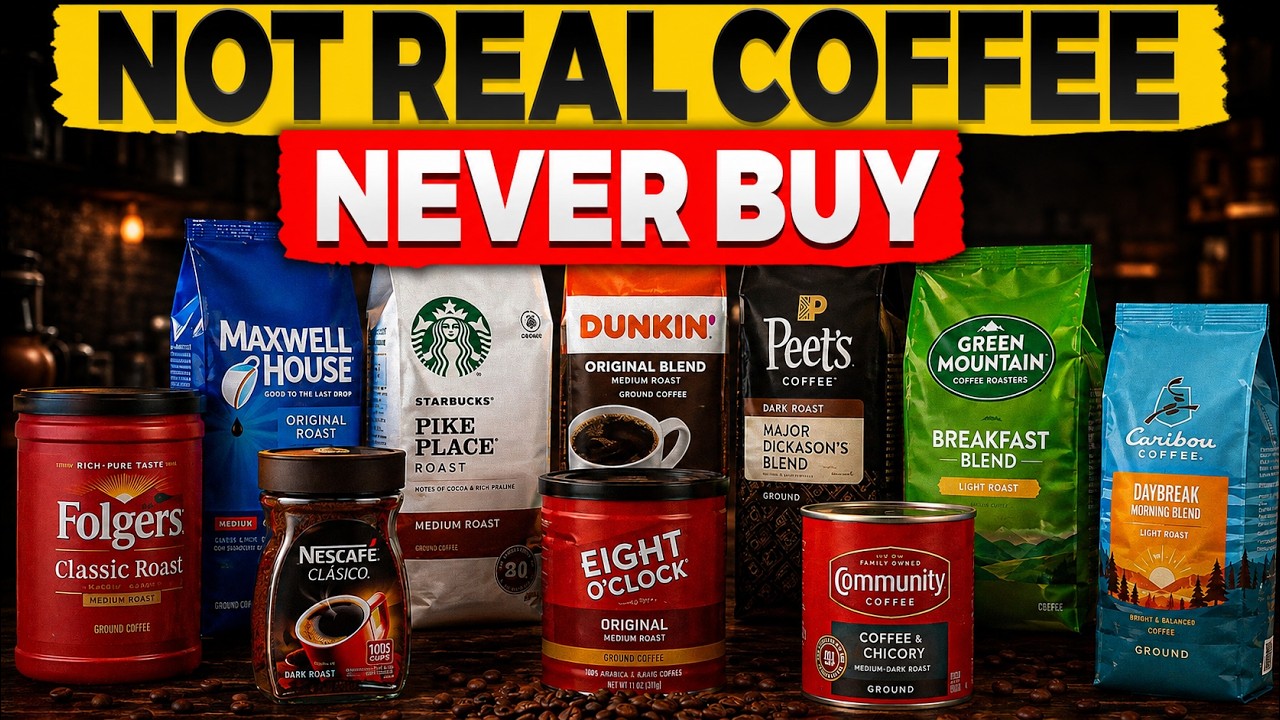
Thumbnail analysis
Pattern: Product shot Trigger: Contrarian
Curiosity 6 · FOMO 2 · Pain 6 · Clarity 8
Text: NOT REAL COFFEE NEVER BUY · Face: no
Naming trusted, familiar coffee brands alongside a bold accusatory claim creates outrage and contrarian curiosity about which favorites to avoid.
Improvement: Add a red X or circle over one or two specific brands to instantly signal which ones are the 'fake' coffee.