Kills everything in 5 seconds (Caterpillars, aphids, mealybugs, ants, flies, and all garden pests)
Garden in Bloom · 764.2K views · 2026-09-05 · 484.8x outlier
Title analysis
Kills {list of pests} in {time} · pain_point · tutorial
Concrete list of pests plus fast timeframe promises an efficient universal solution.
Title features
14 words · number bracket
Script
1983 words · 161 wpm · 12.3 min
Hook: It might sound crazy, but for how many years have you known that garden centers and flower shops don't want you to know secrets like this one? Garden centers make their money selling you expensive pesticides.
Type / score: contrarian · 7/10
Structure: tutorial
Promise: partial
Tone: conspiratorial, instructive, confident
Diagnosis: The anti-garden-center framing and promise of instant results hook viewers early, and the detailed step-by-step recipe with specific measurements and timing keeps specificity high through the middle. However, the title's '5 seconds' claim is never actually demonstrated or proven on camera, and the long soil-health tangent near the end risks losing viewers who came only for the quick pest-kill payoff.
Full transcript with timestamps
00:04 It might sound crazy, but for how many
00:06 years have you known that garden centers
00:08 and flower shops don't want you to know
00:10 secrets like this one?
00:13 Garden centers make their money selling
00:14 you expensive pesticides. Bottles with
00:17 professional labels and serious sounding
00:19 chemical names that cost 15, 20, $30 a
00:23 bottle and need to be replaced every
00:25 season. What they are not going to tell
00:27 you is that there is a homemade recipe
00:30 that works just as effectively, costs
00:32 almost nothing, uses ingredients already
00:35 sitting in your kitchen, and is
00:37 completely safe to spray on edible
00:38 plants. You would never spray a
00:40 commercial pesticide on vegetables or
00:42 herbs you are about to eat. This recipe,
00:46 you can. Today, I am going to teach you
00:48 this recipe to wipe out every kind of
00:51 pest at once. And I am sure nobody has
00:54 ever told you this before. Do you know
00:56 why? Because this recipe is free. Anyone
00:59 can make it with things they already
01:01 have at home. And the result is the same
01:04 as those expensive pesticides that
01:06 garden centers normally sell you except
01:08 that this one being homemade is not
01:11 dangerous and poses no risk to you. It
01:14 works on meie bugs, ants, aphids,
01:17 whitefly, blackfly, caterpillars, and
01:20 almost every other insect pest attacking
01:22 your plants. And beyond pest control, it
01:25 has antifungal action, meaning that
01:28 white or yellowish powder that appears
01:30 on leaves, the powdery mildew that
01:32 spreads from plant to plant and is
01:34 notoriously difficult to stop. This
01:36 recipe tackles that, too. One formula,
01:39 multiple problems, free ingredients. The
01:42 main one is garlic. You have garlic
01:45 right now in your home because garlic is
01:47 the main ingredient in this recipe. But
01:49 garlic alone is not enough. Before we
01:51 get into the recipe, drop in the
01:53 comments what pest is causing you the
01:55 most trouble right now. Meie bugs,
01:57 aphids, fungal issues, something else.
02:00 Your answer helps everyone reading the
02:02 comments who is dealing with the same
02:04 problem.
02:06 Why garlic works and why this is not
02:09 just folk wisdom.
02:11 Garlic contains a compound called
02:13 allisonin that is released the moment
02:15 the clove is crushed or cut. Allisonin
02:18 is what produces the sharp distinctive
02:20 smell and it is also what makes garlic
02:22 one of the most effective natural
02:24 pesticides available. It disrupts the
02:26 nervous systems of softbodied insects on
02:29 contact, repels insects that detect it
02:32 through scent and inhibits the growth of
02:34 the fungal spores responsible for
02:36 powdery mildew and other common plant
02:38 diseases. The antibacterial, antifungal,
02:42 and pesticidal properties are not
02:44 separate effects. They all come from the
02:46 same compound. That is why garlic water
02:48 applied correctly outperforms many
02:51 commercial sprays that target only one
02:53 problem at a time.
02:56 The recipe, what you need, and exactly
02:58 how to make it.
03:01 You need three to five garlic cloves,
03:03 depending on how much spray you want to
03:05 produce. Three cloves produces a
03:07 concentrated batch that makes roughly
03:09 500 ml of finished spray. Five cloves
03:13 produces a stronger batch suited to
03:15 heavy infestations. Crush the cloves
03:17 rather than mincing or blending them
03:19 finely. The goal is to break the cell
03:21 walls enough to release the allisonin
03:23 without destroying the structure of the
03:25 clove entirely. A mortar and pestle
03:27 works well. The flat side of a knife
03:30 pressed firmly onto the clove works just
03:32 as well. A fork pressed down on the
03:34 clove on a plate also works. The method
03:37 does not matter. The important thing is
03:39 that we need to crush this garlic,
03:41 crushed but not pulverized, releasing
03:44 the strong garlic aroma but still in
03:46 recognizable pieces. Place the crushed
03:49 garlic, including the skins, into a
03:51 container and add 200 to 250 ml of hot
03:54 water. Just boiled is ideal. The heat
03:58 helps draw the active compounds out of
03:59 the garlic quickly. Now step away and
04:02 let it sit. Do not use this solution
04:05 immediately. It needs a minimum of 12
04:08 hours, ideally overnight, to fully
04:10 extract the allisonin and the other
04:12 pesticidal compounds from the garlic
04:14 into the water. After 12 hours, the
04:17 water will have changed color noticeably
04:19 darker with a clearly visible infusion.
04:22 That color change is your confirmation
04:24 that the extraction has worked.
04:28 Finishing the preparation.
04:31 Once rested, strain the liquid through a
04:33 piece of old cloth or fine fabric placed
04:36 over the mouth of your spray bottle. The
04:38 goal is to remove all the garlic solids,
04:41 skins, pulp, any residue, so only the
04:44 liquid passes into the sprayer. Solid
04:47 particles clog spray nozzles within a
04:49 few uses and reduce the effectiveness of
04:51 every application. The liquid alone is
04:54 what you want. It carries all the active
04:56 compounds and sprays cleanly and evenly.
04:59 Now, prepare a separate mixture of 200
05:01 ml of clean tap water and two level
05:04 tablespoons of liquid dish soap. Mix
05:06 these together and then add this soap
05:08 solution to your strained garlic liquid
05:10 in the spray bottle. This is the step
05:12 that takes the recipe from reasonably
05:14 effective to genuinely powerful. And the
05:17 reason it matters so much is chemistry.
05:20 Garlic water alone evaporates quickly.
05:23 It dries off the leaf surface within
05:25 minutes of application before the
05:27 allisonin has had adequate contact time
05:29 to work on all of them. The dish soap
05:32 changes this entirely. Soap acts as a
05:35 surfactant. It reduces the surface
05:37 tension of the liquid, allowing it to
05:39 spread more evenly across the leaf
05:41 surface rather than beating up and
05:43 rolling off. It also makes the solution
05:45 significantly stickier, so it adheres to
05:48 the waxy coating on insects and their
05:50 eggs rather than sliding off on contact.
05:53 The result is prolonged contact time
05:55 with the Allisonin, which is what
05:57 produces the results you will see within
05:59 seconds of application.
06:01 If this recipe is already making sense
06:03 and you are planning to make it this
06:05 week, subscribe now. This channel covers
06:07 free and natural plant care solutions
06:09 every week. The information garden
06:11 centers prefer you did not have. Hit
06:14 that button. Application. This is where
06:16 most people get it wrong.
06:19 The most common mistake when applying
06:21 any pest spray, homemade or commercial,
06:24 is only treating the top surfaces of the
06:26 leaves. The top surface of a leaf has
06:29 relatively few pests because most
06:31 insects and their eggs are concentrated
06:33 on the underside where they are
06:34 protected from rain, direct sun, and
06:37 predators. If you spray only the top,
06:40 you reach maybe 20% of the actual pest
06:42 population. The infestation continues.
06:45 You conclude the treatment did not work
06:47 and you go buy something more expensive
06:49 that you apply the same incorrect way
06:52 with the same underwhelming result.
06:54 Apply this spray to both the top and the
06:57 underside of every leaf. Every leaf.
07:00 Take your time. The underside is where
07:02 the eggs are. The underside is where the
07:04 majority of meiebugs, aphids, and
07:06 whitefly are clustered. Reaching the
07:09 underside is the entire difference
07:11 between a treatment that works and one
07:13 that does not. Apply generously enough
07:15 that the leaves are visibly wet, not
07:17 dripping, but thoroughly coated on both
07:20 surfaces. The Allison needs contact time
07:22 to work. A light mist that dries within
07:25 seconds does not give it enough.
07:28 Timing. Never apply under direct sun.
07:33 Never apply this spray or any spray when
07:35 your plant is under direct strong
07:37 sunlight. The combination of water,
07:40 soap, and direct heat creates a
07:42 scorching effect on leaf tissue. The
07:44 liquid magnifies the sun's intensity on
07:46 the leaf surface and causes burn marks
07:49 that look similar to the disease or pest
07:51 damage you are trying to treat. You will
07:53 harm a plant you are trying to help. The
07:56 correct window is late afternoon from
07:58 around 4:30 to 5:00 in the evening when
08:01 the sun is low and the intensity has
08:03 dropped significantly. Early [snorts]
08:05 morning before the sun reaches full
08:07 strength also works. In either case, the
08:10 plant should be in shade or low light
08:12 when you apply. If your plant is in a
08:15 container, move it to a shaded spot
08:17 before spraying and return it to its
08:19 usual position once the spray has dried.
08:21 This single timing rule prevents most of
08:24 the accidental leaf damage people
08:26 experience with homemade sprays. Apply
08:29 every 3 to 5 days during an active
08:31 infestation until the pest population is
08:33 eliminated. Once eliminated, a single
08:36 monthly application prevents
08:38 reinfestation by keeping allisonin
08:40 levels on the leaf surface high enough
08:42 to deter new arrivals. Now, here is the
08:45 part of this video that goes further
08:47 than most pest control advice does. And
08:49 it is the reason why some plants seem to
08:51 get attacked by pests again and again
08:54 while others in the same garden never
08:56 do. Stay with me for this because it
08:58 changes the way you approach plant
09:00 health permanently.
09:03 Why pests are actually a symptom, not
09:05 the problem.
09:08 When a plant is being heavily attacked
09:09 by pests, that attack is a signal. Pests
09:13 prefer weak plants. Specifically, they
09:15 seek out plants with high amino acid
09:17 content in the sap, which is the
09:19 biological profile of a plant that is
09:21 struggling, nutrient deficient, or under
09:24 stress. A plant in genuinely healthy
09:27 soil with adequate nutrition produces a
09:30 different sap chemistry that is
09:32 significantly less attractive to most
09:34 insect pests. This is documented in
09:36 plant biology research and it is the
09:39 principle behind why some plants in a
09:41 garden are perpetually attacked while
09:43 others with the same pest pressure
09:45 nearby are left almost entirely alone.
09:48 Once you have treated the active
09:50 infestation with the garlic spray, dig a
09:52 small hole in the corner of the pot or
09:54 in the soil near the base of the plant,
09:56 not directly at the stem, and add a
09:58 spoonful of Bokashi fertilizer. Bokashi
10:01 is an organic fermented fertilizer rich
10:03 in nitrogen, phosphorus, potassium, and
10:06 the beneficial microorganisms that
10:08 improves soil biology. It feeds the
10:11 microscopic life in the soil that
10:13 converts organic matter into plant
10:15 available nutrition. Cover the hole
10:17 lightly and water gently. The plant that
10:20 was showing pest damage is telling you
10:22 its soil needs strengthening. Treat the
10:24 pest on the surface and treat the
10:26 deficiency underground. Both together
10:29 prevent the cycle from repeating.
10:32 The complete method in order.
10:36 Crush three to five garlic cloves and
10:38 steep in 200 to 250 ml of hot water for
10:42 12 to 24 hours. Strain the liquid
10:44 through cloth into a spray bottle. Mix
10:46 two tablespoons of dish soap into 200 ml
10:49 of clean water and add to the garlic
10:51 liquid. Apply to both the top and
10:53 underside of every affected leaf in late
10:56 afternoon or early morning shade. Repeat
10:59 every three to five days during active
11:01 infestation. Once clear, apply monthly
11:03 to prevent return. After treating the
11:06 pest, add bokashi fertilizer to the soil
11:08 to address the nutritional deficiency
11:10 that made the plant vulnerable in the
11:12 first place. Garden centers charge you
11:14 for solutions to problems they could
11:16 have helped you prevent for free. The
11:18 garlic in your kitchen already contains
11:20 one of the most effective pesticidal
11:22 compounds available. The dish soap under
11:25 your sink amplifies it. The cost of
11:27 treating an entire season of pest
11:29 problems with this recipe is the same as
11:32 one small head of garlic and a few
11:34 tablespoons of soap. That is not a
11:36 compromise on results. It is a
11:38 completely effective alternative that is
11:40 safer for you, safer for edible plants,
11:43 and safer for the beneficial insects you
11:45 actually want in your garden.
11:48 Tell me in the comments which pest you
11:50 are dealing with right now and whether
11:52 you have tried a garlic-based solution
11:54 before. If you have, tell me what worked
11:56 and what did not. That information helps
11:59 everyone reading who is about to try
12:01 this for the first time. If this video
12:04 gave you a free solution to a problem
12:05 you have been spending money on,
12:07 subscribe now. Every week, this channel
12:10 covers the natural plant care methods
12:12 that work without the expensive
12:14 products. Hit that button and go make
12:16 this recipe
Thumbnail analysis
Pattern: Object closeup Trigger: Pain point
Curiosity 3 · FOMO 1 · Pain 8 · Clarity 9
Text: KILLS EVERY PEST ON CONTACT · Face: no
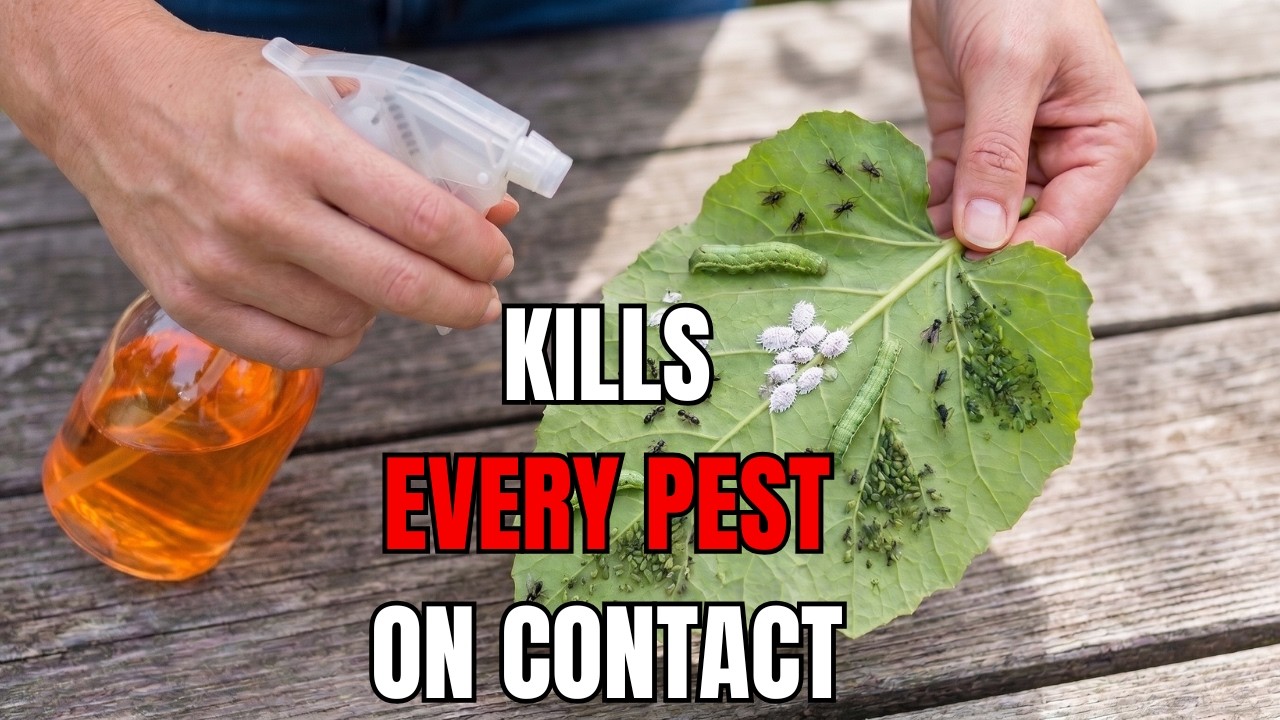
Shows the exact infested leaf and solution in action, promising an instant fix to a universally hated gardening problem.
Improvement: Add a visible before/after split to emphasize the transformation and boost curiosity.